
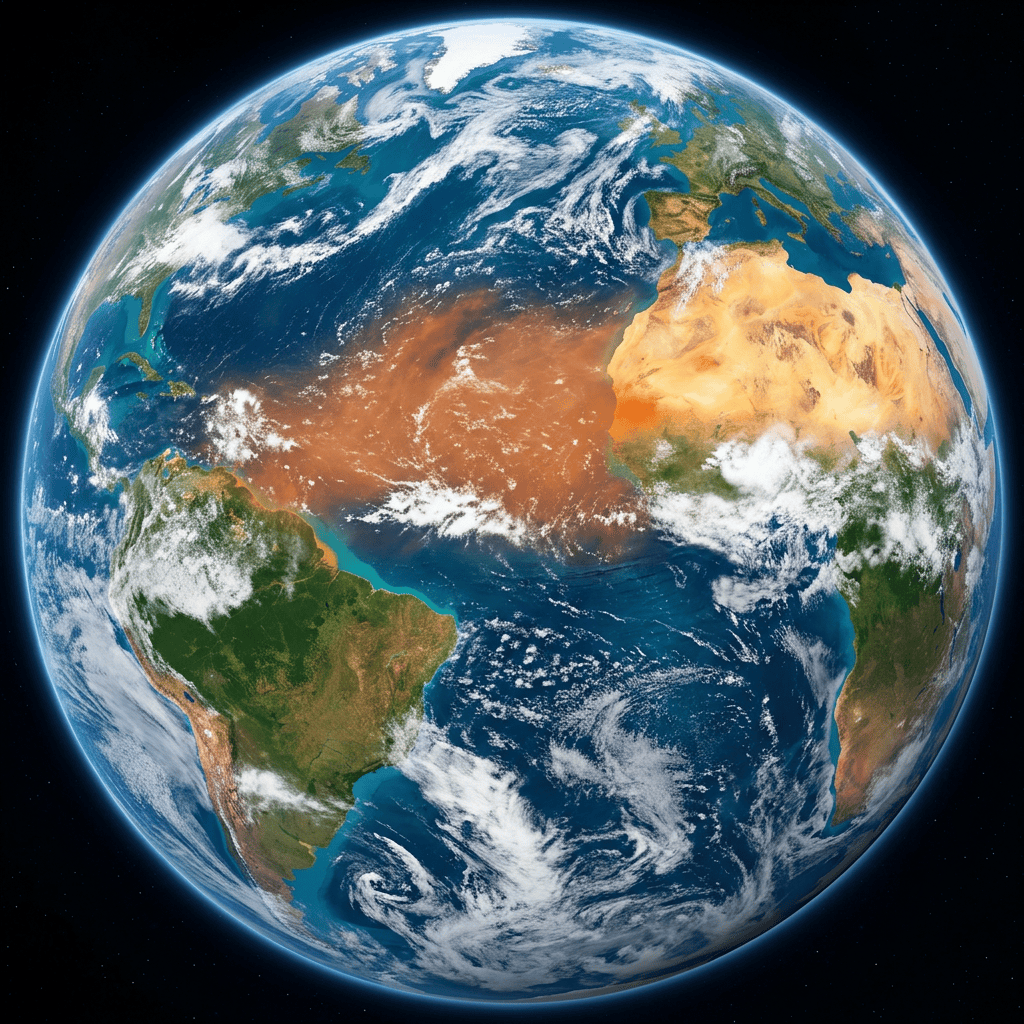
Several times a year, Portuguese weather specialists warn us about plumes of dust from the Sahara shrouding our shores. They issue health warnings to the population: close all windows; restrict outdoor activities, especially older people, children, those who have breathing difficulties, and those who suffer from asthma. What a silly thing, I thought at first. Dust from the Sahara – is it a real phenomenon? Does it cross the Mediterranean sea to settle in Portugal?
Saharan dust has a busy nomadic life that affects much more than a few south European countries. It has been studied by scientists and followed by several satellites that track the dust clouds over the globe. Turns out peripatetic Saharan dust spreads over wide territories and even has a dedicated Wikipedia page.
Powerful winds lift the dust from the Sahara desert, and in combination with other winds, swirl it into the troposphere and from there in three directions:
· North: dust crosses the Mediterranean and southern Europe, and sometimes extends towards Scandinavia
· East: dust flies toward the eastern Mediterranean and the Middle East
· West (also known as transatlantic transport): dust glides towards the Gulf of Guinea, the Caribbean, the United States of America, and South America. Check out his Saharan dust plume from the European Space Agency
All that twirling dust has to land somewhere. Dust deposition on the European continent is about 25 million tons per year, something that coats my car (and others’) with a spectral flaxen lace that nobody appreciates. Part of that dust lands also on pristine snow from the Sierra Nevada on the south of Spain, as well as on Mont Blanc, the highest point of the French-Italian Alps, and they show patches of yellowed snow. Oxford (UK) has received its share of uninvited dust, as well as many other unsuspecting places. Depending on continental winds, dust can sometimes reach Japan.
Floating west, scientists estimate that about 170 million tonnes of dust settle on the Atlantic ocean each year. Saharan dust is so fine that it becomes part of the elements that feed fish and other sea dwellers.
Dust that hovers westernmost reaches the Amazon region, which is described by some as the lungs of the world. But there’s no such thing. The oxygen the Amazon produces is used up all by itself for survival.
It turns out the Amazon region needs Saharan dust to survive.
I lived in the Amazon for almost eight years. Before you ask me, let me write answers to real questions that have been lobbed at me through the years. I did not: live in the jungle; live in a house on stilts by the river; live among the Indians; sleep in hammocks (although they were unparalleled to lull babies into sleep); walk about shoeless like the Indians; hop around undressed like the Indians; hunt animals and cook them on an open fire (although we did throw some scorching barbecues). And no, Native Brazilians do not favour cannibalism nowadays. Maybe.
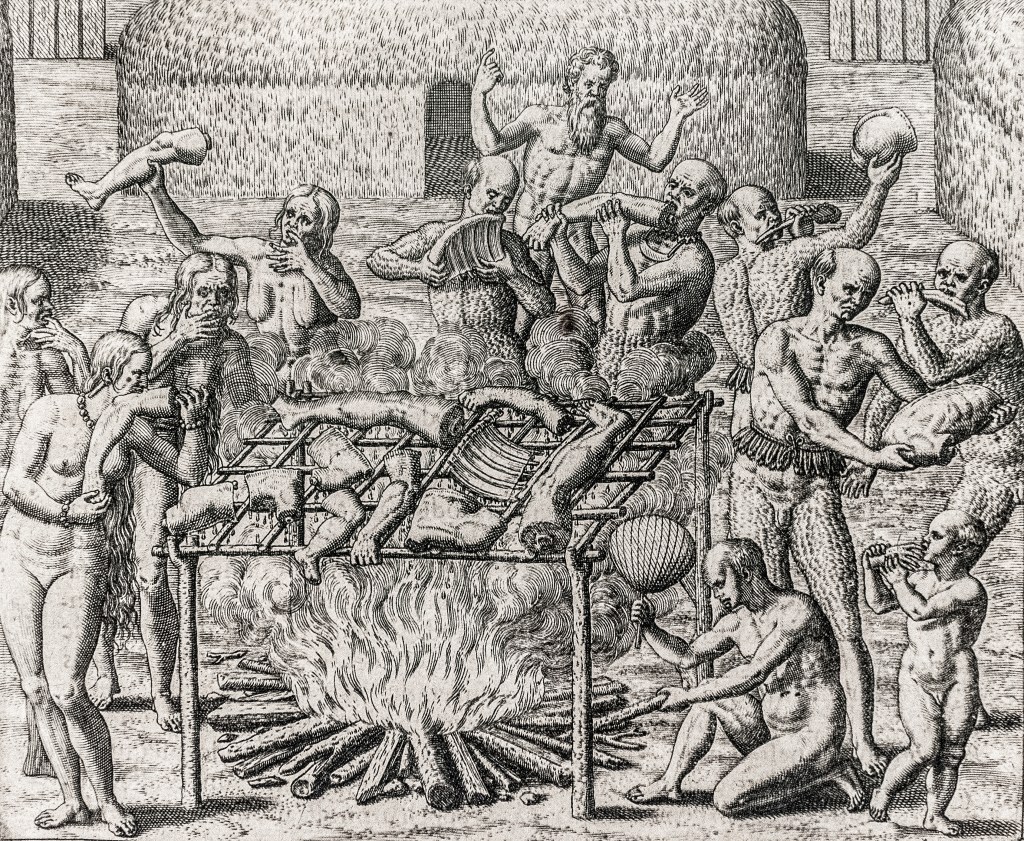
Theodor de Bry circa 1593. Source
I went to Manaus, the capital of the Amazon state in Brazil, because of Husband’s work at the largest research institute in the Amazon. The Brazilian government had heaped money on the institute because if they didn’t other countries would. Foreigners had already been poking the region with their scientific instruments, and had flogged countless bibles around. The dictatorship was in full force, and they decided that it was best to employ foreigners who would then develop a local scientific community. And it would be easier for them to keep a close watch on their work.
Manaus sprawled itself at the confluence of two rivers: the Solimões, muddy, lazy and portentous all the way from the Andes; and the Negro, dark tea streaming from the north. From that point smack in the middle of the Amazon region, the two rivers become the mighty Amazonas, the largest river in the world by volume of water. It flows for 1,600 kilometres and disgorges into the Atlantic ocean. The Amazonas was the umbilical cord to civilization.

For me, moving to Manaus was one of those things you do when you’re young, and you think, if I don’t do it now, I’ll never really do it. And then, after you’ve done it, you wonder why you did it. I was seven months pregnant when we flew in, a bit like west-bound Saharan dust, from London to Rio de Janeiro, then Brasilia, and finally, Manaus. In that January, the London I left was foggy and half-frozen. The Manaus I landed in was hazy in its equatorial heat and humidity. Upon my arrival I was told by the research institute’s director that the best hospitals in Manaus were called “Vasp, Transbrasil or Varig” referring to the three airlines that served the region and, “You should do the reverse of the trip you have just done.”
Back then nobody really talked about what a big thing it was to move as we did: several thousand kilometres away from civilization, without that vital support network of family and friends. Nobody worried about birth difficulties, bad doctors, or filthy hospitals. We just did it. Dr. Spock’s (not the half-Vulcan) Baby and Child Care weighed in my luggage, as well as books from naturalists Henry Walter Bates and Alfred Russel Wallace who explored the Amazon in the 19th century. I had my priorities right, and I knew all I needed to know to rear and defend my firstborn from the threats of peri-urban life in the Amazon with its ravenous mosquitoes and giant fire ants.

Yes, I knew their language, but I’m from the south of Brazil, so I learned new expressions, pronunciation and intonation. Everybody was maninho, little brother, or maninha, little sister, regardless of age. You could believe the whole city with its half-million inhabitants was one big family, but it was a riverside city subject to extraordinary rainfall and floods, and if you lived in the wrong place, the concept of brother- or sisterhood disappeared in a jiffy. If you asked for directions, everything was “Over there”, accompanied by raising the head slightly back and thrusting the chin forward, pointing in the approximate direction. I called it the Amazonian chin-wag: it was too much work to lift a hand and point, or give accurate directions.
I was told several times (and I don’t see why I shouldn’t tell you, too) that I could set my watch by the rain. During the rainy season, no appointments were made for 4 pm, when we expected the deluge to pound the city without pity. If you were caught without an umbrella or some form of protection, it felt like some sylvan jinn was pelting your head and pinching your arms. In the aftermath, you admired the glittering green leaves while you tried to breathe in the heavy air.

UNESCO World Heritage Site. Source
Manaus in the 1970’s still retained signs of its rich past linked to rubber extraction from 1890 to 1920. Rubber barons built mansions and palaces, the Metropolitan Cathedral and the Amazon Theatre. The city ordered building materials in Europe, and it was said that its wealthy townspeople sent their laundry to Paris. Manaus was the second town in Brazil to have electricity, and its public Federal University of Amazonas opened in 1909.
A threadbare Manaus steamed in its ancient and dilapidated establishments until 1967, when it became a duty-free zone. That brought an assortment of multinational factories to its Industrial District and an array of shops selling imported everything: Italian gold painted wooden trays, English dining sets, bolts of cloth, Patek Philippe watches. Tourism was geared to its sweaty overstuffed shops, and incursions into the nearby jungle to watch a group of genuine female Indians perform a genuine dance while their bodies were encased in genuine 20th century apparel that hid body parts that could offend visitors’ refined mores.
Everything that we needed or wanted arrived in ships that sliced the muddy Amazon water 1600 kilometres inland from its mouth in the Atlantic. Among my acquaintances, the most appreciated cargoes were cauliflower for the adults and powdered milk for toddlers. Both were objects of passionate phone calls, “Run to the supermarket before they sell out!” At the same time, we had many local vegetables, such as the meter-long green beans, and the pupunha palm fruit which, depending on the buyer’s luck, could be fibrous and dry, or silky and moist. Fish was plentiful, from small piranhas to the giant pirarucu. Like Manaus, you never knew what you were getting until a new ship arrived. The exception was beer: supply was guaranteed by two rival local breweries. We met the master brewer of one of them at a function, and he was drinking his rival’s beer. When I asked why, he said, “I’ll never drink my beer because I know what’s in it.”

Around us, the river licked the land and devoured its banks each year. We did what was necessary, and drifted with the flow of our lives. And in our years there, I’m sure we swallowed a lot of Saharan dust while being totally ignorant of it.
The Saharan dust that reaches the Amazon has its partial origins in a dry lake in the Bodélé Depression in Chad. Strong winds lift around 180 to 200 million tons of decomposed organic residue that cross the Atlantic. Part of it settles over the Amazon. Scientists have calculated that the dust that settles on the Amazon contains about 22,000 tons of phosphorus, an important fertilizer. That, they say, is the same amount of phosphorus that leaches from the Amazon soil each year through rain and rivers. The forest has reached her balance.
The Amazon is not a romantic idea of infinitely fertile soils with trees and fruit to feed and provide oxygen to the world. Amazonian soil is poor, barely enough to feed itself. Whatever drops into it, leaves or dust, is gobbled up by the forest to keep all beings striving towards equilibrium and survival.
Saharan dust sprinkled by nature over the Amazon (and other places) is an example of the Gaia hypothesis. The earth is Gaia. I come from a time when Gaia’s organisms and atmospheric events worked in synergy to perpetuate her life. Gaia could, back then, heal herself. It was up to us not to tip the scales. But haven’t the scales tipped with the disruption of natural processes? Our planet has become a basket case and we’re all in it together.
To prevent despair, I close my eyes and wish for petrichor emanating during the first drops of an Amazonian storm. Can I turn the clock back? Of course not.
I hear another Saharan dust plume arrives tomorrow. At least that part of Gaia is still working. Dust to dust.



.jpg)
One response to “Dust to Dust”
Dear Regina We really enjoyed our lunch last Friday, and thank you for the books. My learned experience is that emotion is a key driver, and I steer diplomatically rather than challenge. Any activity which occupies Lynne´s attention and time is valuable, since it frees my time too.
This dusty piece is an excellent addition to your output, and I particularly enjoyed the image of the two rivers together. I find it difficult to imagine a normal variation in the level of the river of around 10m, while an abnormal of more than 13m. I have just discovered that most of the world thinks of the Amazon River from Peru to the Atlantic, but Brazilians count only that part from Manaus to the sea, calling the upper Amazon the Solimões.
Thank you – very interesting – particularly your personal experiences. Best wishes to you both Peter
>
LikeLike