
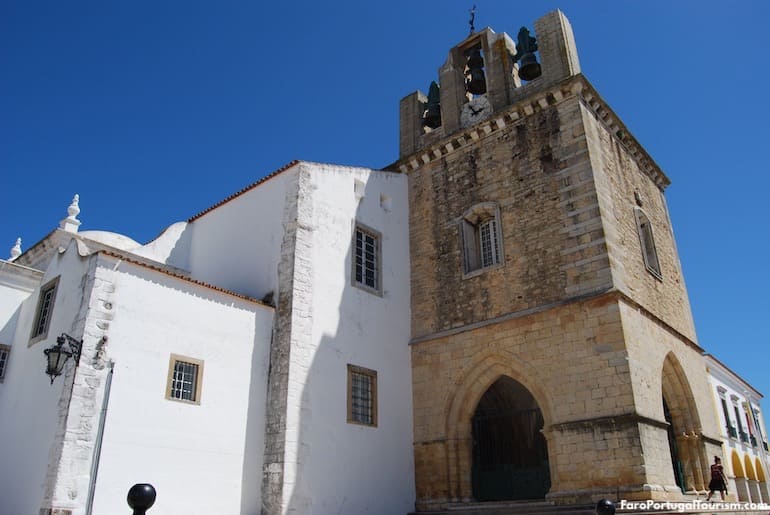
Family was visiting and I became an unofficial tourist guide at Faro Old Town. We alighted at Faro’s Cathedral, or Church of Saint Mary. The last time I visited it had been free, and I felt like a nabob crossing under the old gothic arches of the bell tower and the front door. This time the front doors were locked. So we battled, as if we were in the 11th century, to enter an opponent’s place of worship. We could have been Visigoths, Moors, or Catholics going up the only entryway to the cathedral, the relatively new side ramp that zig-zags and serves wheelchairs and pedestrians. It’s the strangulating ribbon for those going in and for those going out, and it all happens at the same time. There’s no traffic light to organise the throngs. There’s no “Excuse me,” in any language, that makes this grovelling entrance to and exit from Faro’s cathedral a pious experience. There’s no ecstasy, just penance, up to the top, where we faced the ticket seller already entombed in his glass cubicle like a relic. We felt like gate crashers until we paid the graciously reduced entrance fee for those over 65. Small blessings.
I explain to my group of visitors: the local architecture suffers from an acute insecurity problem. It results in cheap local solutions like the ramp with multiple personality disorder. We persevered in our penitence.
Faro Cathedral has been destroyed at least three times: by the Earl of Essex in 1596, because he could loot it; and by two earthquakes, in 1722 and 1755. The cathedral’s current version abuts a surviving bell tower, but the rest is in the Chão style, or simple architecture: devoid of outside adornments, its straight lines as austere and uninviting as the king who demanded the architecture to be so, perhaps to save money on a church away from his throne, therefore unlikely to save his soul.
While the cathedral’s outside is plain and white, the inside is an ode to renaissance, baroque and gothic styles distributed among 12 chapels, all of them dripping with a plethora of decorations in gold and painted tiles. It reminded me of someone who’s redone his office in Washington, but this is the real stuff, the chapels and altar pieces are no comparison to a crude office redo. The gold is genuine. Or so they say. And there’s not a single police officer around or inside, trying to prevent looting or misbehaviours.
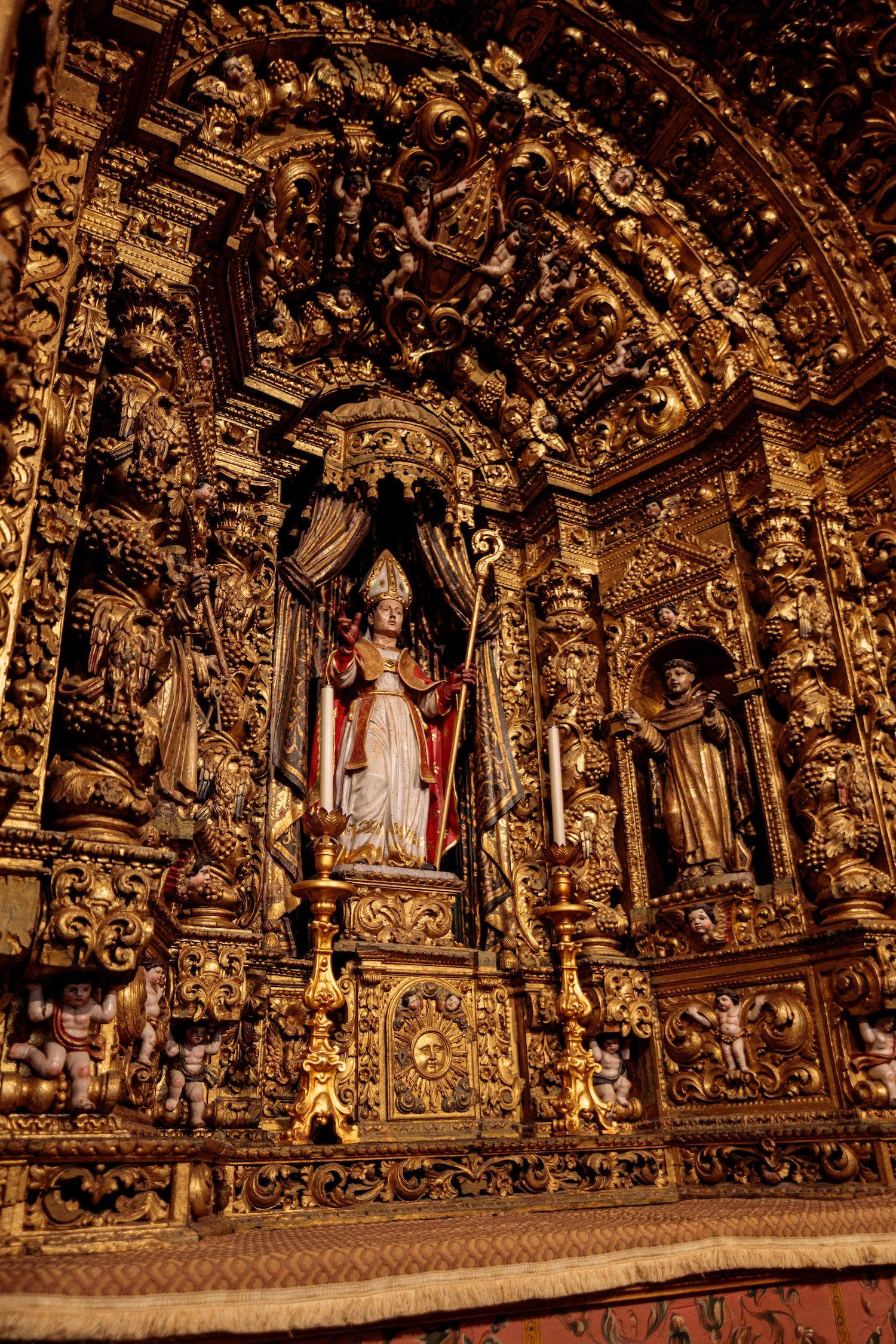
The Chapel of São Brás, the only one to survive the earthquakes, is decorated with an uninterrupted glistening gold sheet, bottom to ceiling, left to right. The gold came from Brazil, as the Portuguese took what they thought was theirs. São Brás is surrounded by grape vines that climb many columns. I don’t know the significance of grapes for São Brás, but they are attractive enough to deny the external architecture its simple name.
I lit a candle. It’s a habit whenever I visit a church, which doesn’t happen often. If there’s a candle to be lit, somehow I gravitate towards it, and find the money slot. I slid in a coin, listened for the click-clack-click of the numinous in action, and as if by miracle the plastic candle lit up, winking weakly as if unconvinced of its power. O ye of little faith.
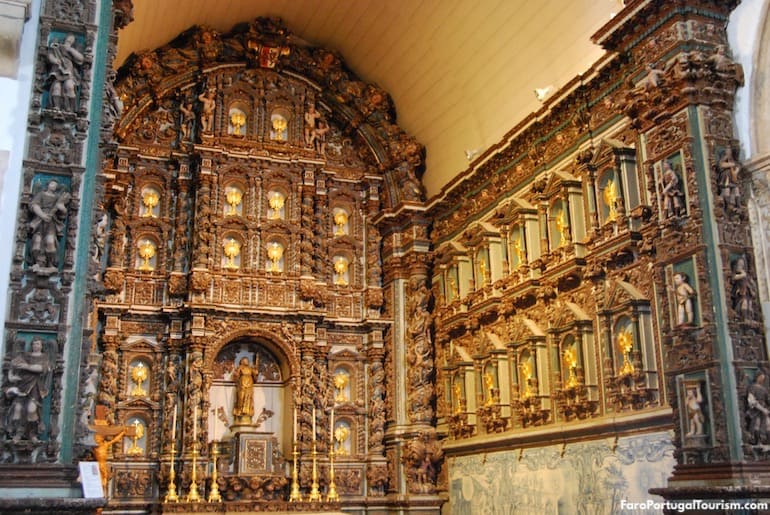
The main attraction of Faro Cathedral is the Chapel of Relics. It holds the relic of St. Vincent, the Algarve’s Patron Saint, plus other saints’ reliquaries arranged with military precision on the surrounding walls. St. Vincent was from Zaragoza, Spain, and worked in Valencia, where emperor Diocletian ordered torture against Christians. After withstanding so much torture that it was deemed humanly impossible, the emperor, who didn’t want Vincent to become a martyr, told his minnows to put Vincent on a soft mattress. Thereupon Vincent died. Diocletian ordered his body thrown in the water to disappear, but it always managed to return to a beach. Diocletian then ordered his soldiers to put the body in a sack and tie it to stones. Indeed, Vincent’s body disappeared, but only for long enough for it to turn up at the Algarve and be buried near Sagres in 304. Or not: St. Vincent remains are supposed to have gone to Metz in France, or to the Greek island of Momenvasia. Who knows. Centuries later, the first king of Portugal Dom Afonso Henriques (1139-1185) learned that St. Vincent was at rest in Sagres and launched a rescue mission of his remains. The name of St. Vincent was given to the cape near Sagres from where the group took off on its mission to move what was left of St. Vincent to Lisbon. It took another 850 years for St. Vincent to return to the Algarve in 2024. By then, what arrived back was just a little bone from his little finger.
As Portuguese historian Paulo Almeida Fernandes wisely said, “We need to put things into perspective that truth, during the middle ages, is different to ours.”
How Relics Started
The veneration of relics, objects associated with a saint, or a place or something that became sacred by association, predates Christianity and belongs to sacred rituals of many cults and societies. Relics invest their owners with honours and privileges; protect and bless them, and perform miracles. Relics have lent power to monasteries, convents, churches, and individuals.
Historically, every church worth its political influence, the volume of money in its coffers, and lastly, the salvation of its flock, has to own one relic of note. The bigger the relic the better, to surpass all the other churches in the county. And the more relics the better, too. Relics have always been a source of wealth, as pilgrims paid to see or touch them. Besides, annual fairs, markets, traders, inn-keepers, the whole town and countryside could depend on the foot traffic brought by a relic. Back then they didn’t depend on narrow zig-zag ramps to get everyone inside the churches.
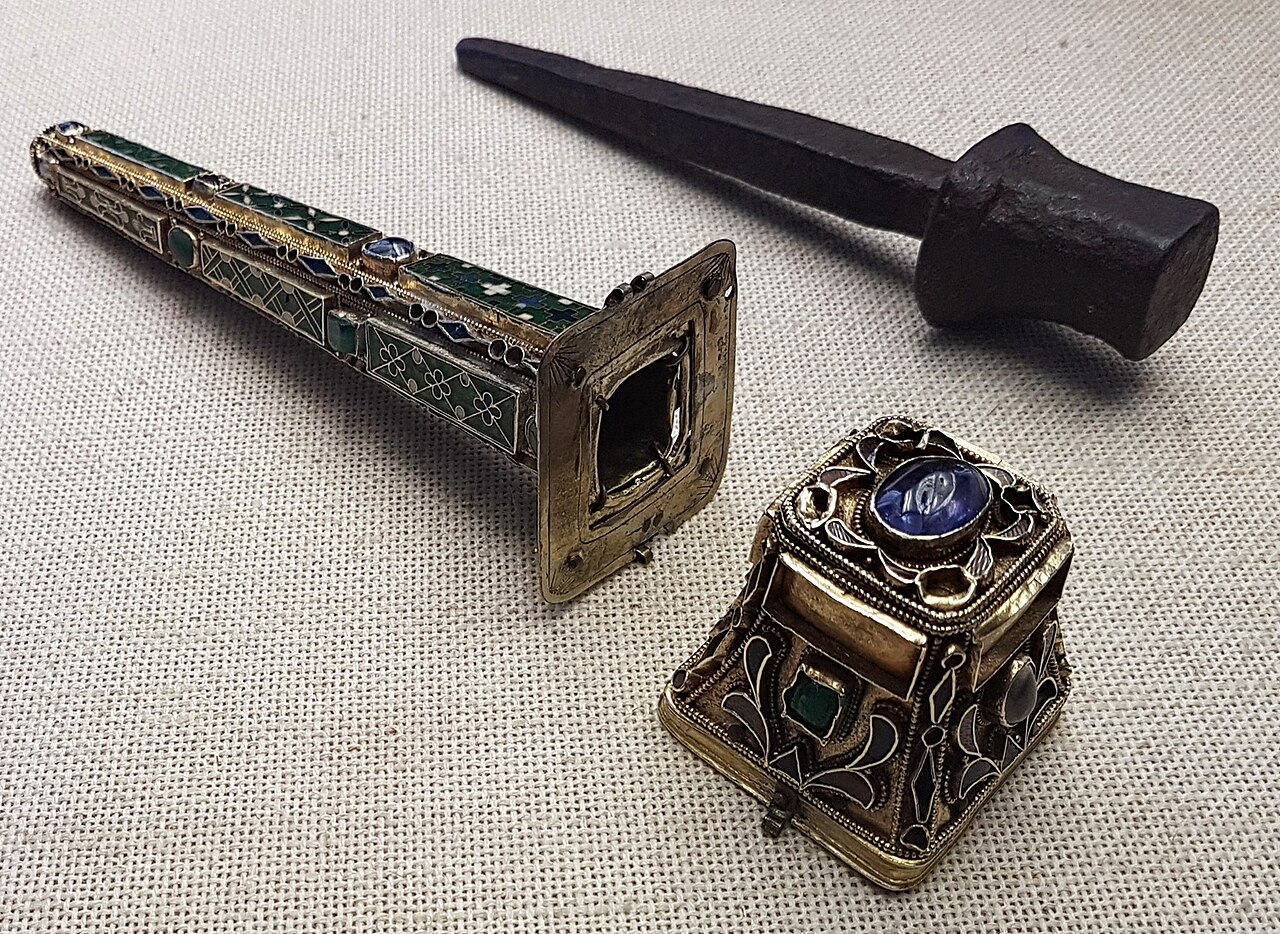
But there was never any certainty that a relic was real, even when certified by a pope or bishop. St. Augustin, back in the 4th century, denounced impostors in monks’ habits selling “spurious relics”. Charlemagne kicked off the age of relics in the 8th century, when he decreed that every church should own relics. Fraus Pia, or pious fraud, triggered the production of instant relics that flooded the majority of civilised countries then. Of course, fraus pia has nothing pious about it.
The Golden Age of Relics happened between the 9th and 14th centuries, when it was en vogue to show off sacred relics inside reliquaries and sanctuaries. Relics collectors went hand in hand with falsification on a colossal scale. These relics were placed in simple leather bags, or in sophisticated reliquaries made of gold and silver, and decorated with gems.
Although it’s practically impossible to identify who perpetrated the falsification, it’s possible to identify from what materials the relics were made of, or if a relic has a chance of being real. A relic said to have been the cerebrum of Saint Peter’s was identified as being a piece of pumice. In Sri Lanka, there exists a Budha’s tooth which is just like a tiger’s tooth, as well as a relic of the big toe from the right foot of goddess Sati, who is a mythological figure. Pope Gregory V (papacy 996-999) found Mary’s wedding ring, even though Jewish people did not use wedding rings in the 1st century.
Relics Classification
Relics are classified like football league teams or train carriages: First, second and third classes, all explained below.
Third Class Relics
A Third class relic is an object that has touched something that once belonged to a saint or martyr, or touched the saint him/herself. It can be a piece of cloth that was touched to a saint’s tomb; a medal that was touched to the shrine of Our Lady of Fatima; printed cards with prayers and the figure of the saint.

Back in the 14th or 15th century, in St. Rita’s Monastery da Cascia, Italy, Sister Rita was taking five from all her duties of cleaning, washing, cooking. But Mother Superior came down the stairs, and noticing that Sister Rita was just twirling her thumbs, which was inadmissible, she said, “Sister Rita, I think we need some greenery here. Get a grape vine and plant it over there.” Obedient Sister Rita planted the vine. The official version is that Mother Superior asked Rita to water a dry twig. From there a vine grew. Now, every year, during autumn, the sisters collect all the vine leaves turned yellow and brown, and turn them to powder. They place the powder in a blue envelope and try to sell them. But they know that relics are not supposed to be sold, so they push the envelope and ask for a donation. St. Rita is considered the Saint of the Impossible, so who knows what miracles and fortunes the powdered vine leaves have brought to pilgrims, the monastery, and basilica in Cascia and beyond. (I wonder what they did with the holy grapes.)
Second Class Relics
These are items used by Christ, or a martyr or a saint, such as gloves, shirts, books, rosaries. There can be no end to them.
Jesus, despite his almighty position in the celestial pantheon, has also produced some second class relics: a piece of bread he shared with his disciples, and shreds of his cloak. However, the astronomical number of true slivers of the True Cross provoked the author Gordon Stein to remark that there are so many pieces of wood supposedly from the Holy Cross that he could build a good-sized ship with them. The same happens with chips off Noah’s Ark, and the manger. But relics sellers seem to have lost their coyness or their manners: a bit of the Holy Cross is for sale on ebay.
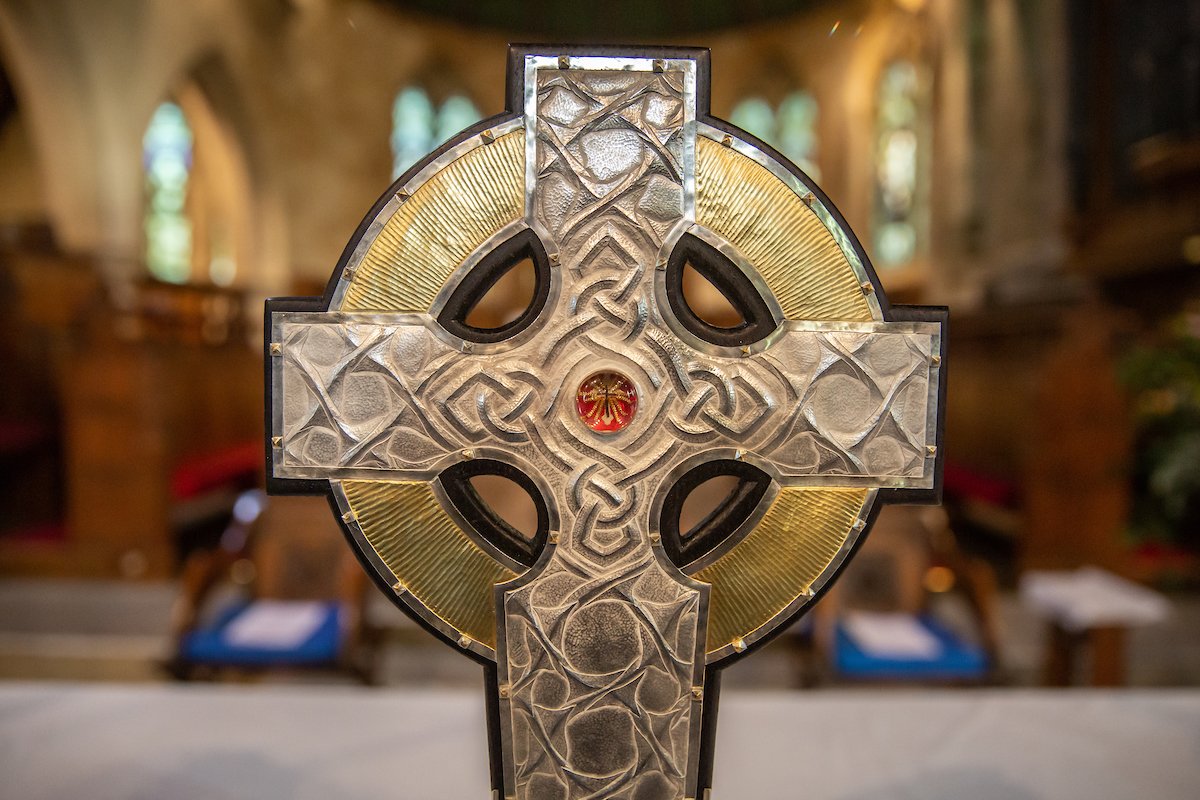
In a possibly apocryphal note, I recall Wallis, Duchess of Windsor, who had a penchant for pricey, large jewellery. She was once given a piece of the True Cross by a priest, and she asked him, “What’s it made of?” The priest said, “It’s the True Cross! Made of wood touched by Jesus Himself!” She replied, “You can leave it on the table. I’ll send it to Cartier for them to make me a copy.” Which begs questions: Are copies of relics as powerful, or as expensive, as the original relics? Can a relic be demoted from second to third class, or to no class, if there’s a Cartier hallmark on it? If so, who would do the demotion? Inversely, would the Cartier hallmark make the relic go up a notch?
As to the nails of the Holy Cross, there are over 30 real nails in Rome, Monza, Catania, Sienna, Escorial, Venice… It’s a matter of researching how many nails the soldiers used back then – perhaps four? But it appears creative people were making copies of the original nails, just like the Duchess wanted to do with her bit of the cross.
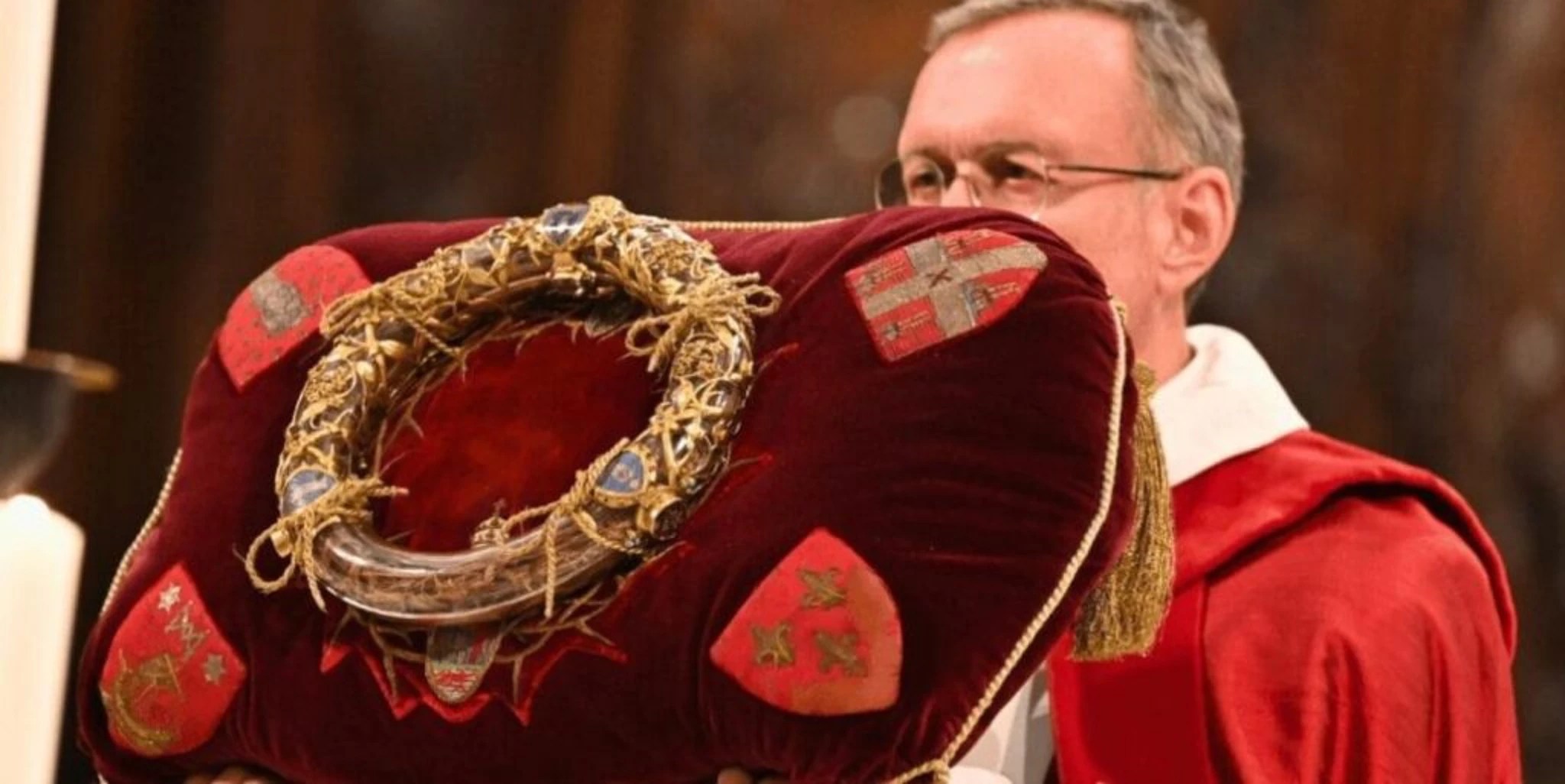
The Crown of Thorns was saved from the fire at the Cathedral of Notre Dame in Paris, and it’s now back where it’s always been, revered by pilgrims. The Vatican has refused to authenticate the object. Just to put that into perspective, there are other 21 reliquaries with multiple or individual thorns, and apparently there are over 70 thorns spread around the world. We get all this mess because they forgot to count the original number of thorns in the crown.
Another Second Class Relic is the much-venerated Sandals of Jesus. They burst history’s veil with impeccable provenance: from Pope Stephen II (752-757) to Pepin the Short, King of the Franks and Charlemagne’s dad, who donated it to Prüm Abbey, in Germany. After undergoing scientific analysis, the sandals were discovered to have been made of cloth from the 5th to the 8th centuries.
First Class Relics
First class relics involve the physical remains from Christ, a martyr or a saint. Countless are the reliquaries that purport to contain drops of blood from almost every saint in heaven. Many reliquaries are said to contain drops of Mary’s milk or hair.
Now, take St. John the Baptist’s first class relics: his whole head rests at Amiens, Lyon, Morienne, Argely, Rome, Spain, Germany; his complete body lays in Bulgaria, Turkey, Montenegro, Italy, Greece, and Egypt; his fingers are in Besançon, Toulouse, Lyon, and Macon. Surely nobody could ever doubt the veracity of those relics.
Something similar happens with other saints. St. Lazarus has full bodies at Marseille, Autren, and Avalon. St. Mattias, on the other hand, can be found with three bodies, a head and an arm, but St. Sebastian wins with four bodies, two heads, and four arms. If I had to choose a winner, I’d go for St. Anne with her two bodies, two heads, and over 100 limbs.
St. Peter’s bones have famously rested in the crypt of the Basilica of St. Peter in the Vatican. But he’s got a second body and two heads, a spare jawbone, and countless tufts of beard spread around Europe.
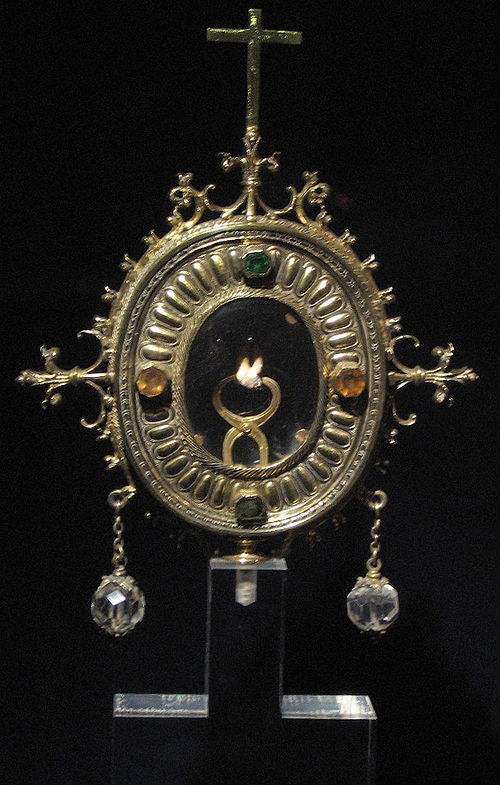
Then there’s the case of St. Apollonia of Alexandria, who died in 249, after torture during an uprising against Christians in Alexandria. Her torturers pulled out, or broke, all her teeth. In a possibly mythical tale, a pope had a clever idea, and told his eminent representatives, “Let’s put St. Apollonia’s teeth together. Spread out through Europe, get all her teeth and bring them to me.” When the pope’s representatives returned they put all of St. Apollonia’s teeth in a bushel, and another, and another. In the end, they had filled 6 bushels with about 43,540 teeth. Unsurprisingly, St. Apollonia of Alexandria became the Patron Saint of Dentistry, a helper for toothache, and the original Tooth Fairy in Italy.
But we also have Jesus’ first class relics that have included his tears, nail clippings, hair, beard, umbilical cord, milk teeth, and blood. Then there’s case of the Holy Foreskin.
We’re on shaky ground here, as the Vatican decreed in 1900 that if you talk or write about the Holy Foreskin, you will be excommunicated. So, if you read this, do not talk about it.
Now, our friend Charlemagne received the holy foreskin as a present. Different versions say he received it from 1. an angel, 2. the Christ Child himself in Jerusalem, and 3. the Empress Irene of Athens, as a wedding gift. (They liked that sort of thing back then.) Perhaps the gift did not work as Charlemagne thought it should, so he regifted Jesus’s foreskin to Charroux Cathedral. From Charroux the foreskin was re-regifted to the Lateran Basilica, in Rome. In the 12th century, Pope Innocent VII refused to authenticate the relic. Depending on who you read, you’ll find that the worldwide distribution of Holy Foreskins numbers 8, 10, 12, or 18. I think that’s a stretch, even for the son of God. But who knows?
The church in Calcata, Italy, housed the holy foreskin saved from the sack (no pun intended) of Rome. Since the late 1500’s the villagers held a yearly pilgrimage, a procession, and a huge sale of indulgences promoted by the Vatican. Nobody was excommunicated. They celebrated their foreskin-fest for almost 500 years, and all of a sudden the relic disappeared in 1983. To this day, it’s thought that the foreskin was stolen by thieves, or by someone from the Vatican, or both.

There’s no end to this inquisition of relics. But I realise I have to end it somewhere.
Leo Allatius (1586-1669), who was a theologian, a physician, and the world’s “first” vampirologist, had a theory about the Holy Foreskin: Jesus’ foreskin had ascended to heaven with Him. But on the way up, the foreskin had become the rings of Saturn.
Hence the zig-zag ramp. It all makes sense.



You must be logged in to post a comment.