

The shock retrieved my memories of armoured trucks, cars and military personnel patrolling public spaces and residential areas. Tanks stood at road intersections surrounded by armed soldiers in times of relative peace. It was Brazil during the old dictatorship.
And it was America, 2025.
Mine was a bitter smile, “ They’re using their manual on themselves. And they haven’t even updated their rules.” The Brazilian dictatorship, supported by the United States of America, lasted from 1964 to 1985. Sadly, I see parallels between Brazil back then and America now.
Brazil was part of CIA Operation Condor to end communism in South America. We welcomed Americans who landed in Brazil to train our special military police and armed forces, to help us annihilate communists who threatened our supposedly perfect way of life. The Cold War had reached the balmy tropics with militarism, torture, murder, disappearances, and curtailment of civil rights.
My family and I survived the dictatorship unscathed. We were among the frightened, quiet ones who did not make waves. Privately, my grandfather raged against the political situation, the dictators, the military, the torture, the persecutions. Publicly, we accommodated to dictators’ whims. We abhorred the communists (or said we did) who were popping up in Brazil, Chile, and Argentina, causing trouble and planning to take our houses, cars, and jobs. We must stop them! I never heard, though, that foreign communists were infiltrating and shattering our society to eat our cats and dogs, and rape our women.
When I was nine years old, school busy-bodies discovered I had not been christened. The headmistress, who owned a nose as pointed as her wimple, insinuated I still carried the original sin, and perhaps worse, “Is yours a communist family?” I was christened, and did penance: daily Hail Marys and Our Fathers before the first class, catechism class to make up for my religious ignorance, compulsory mass on Sundays and Holy Days. Purged of all real and imagined sins, I became as pure as all the torturers and assassins around us.
Sometimes I stayed home on school days, or changed my school route to avoid tanks and armed soldiers. As a kid, I asked, did they carry real guns and scalping knives? Who were they waiting for? Who were they going to kill? I dreaded not only the communists, but those who represented the law. Of course, that’s what the military wanted.
The armed forces and their sinister supporters controlled communication and information. That click-crack-click when you picked up the phone? Someone was listening, so be careful what you say, don’t mention names, don’t say where you’re going.
Fear and ignorance reigned during the dictatorship era. A neighbour snitched on me to my mother, which, let’s face it, was better than snitching to the police: I had been carrying a book with a strange title, an author with a funny name. It was Cancer Ward by Aleksandr Solzhenitsyn, winner of the 1970 Nobel Prize for Literature. That, in itself, was enough to qualify Solzhenitsyn as being against mindless communism, but I was told to hide the book, “You don’t want anything bad to happen to us.” I could have made a fuss, but that book was way above my paygrade as a teen, anyway. Maybe I should have fought for the principle of, if not reading, at least carrying a book by a Russian author.

When I was at the University of Brasília (UnB), an invigilator turned up once in a while. He was usually a man whose hostile face and bloodthirsty eyes filled the Political Sciences classroom with silent terror, attended a class and took copious notes for his secret police report. He had to guarantee that each professor, and each of us students, stuck to norms of political behaviour stipulated by the CIA and his military masters.
The positive part was older students counselling younger ones: be careful what you write in your essays because the special readers will grade them for communist ideas before the professor does. And pray tell me what is a communist idea? Someone said it was anything to do with good for the people, end of poverty, end of hunger, end of the concentration of riches. Yeah, right, who’d want that? Look at the state of Russia! Read Solzhenitsyn!
I never thought that I’d say that we were lucky that a colleague’s father worked in the military, the enemy of the people. Our colleague learned from his unsuspecting source and brought his whispers to us: don’t come to campus tomorrow. We understood repression would attack full of weapons and bullets and destruction, so we spread the news to a few trusted friends and scarpered on that same day, skipping classes and promises, grateful that we had been warned in advance.
One of our greatest problems was on whom to trust. Any colleague could be a military or police informer. Some were.
One day troops invaded the laboratory where a Swiss acquaintance researched DNA. His lab equipment was broken to smithereens, his papers and notes taken away, never to be returned. He escaped with a bruised arm, which was light in the view of things, and eventually rebuilt his research. But the event shows how badly informed those agents and their bosses were.
Universities, back then, became centres of knowledge crushed by tanks, cleansed by blood. At UnB, every university president from 1965 to 1985 was “indicated” by the military. The military had to put the kibosh on dissent. Bowing to the government, universities turned into indoctrination centres, tightly controlled and starved of support. Any fresh idea that elevated humankind, or had communist roots according to them, was under suspicion and had to be choked.
With increased ignorance and savagery, countless university students and professors all over Brazil were held in unlawful detention centres, tortured, and/or disappeared. The lucky ones, if such existed, survived. Some became political exiles in Europe and South America, and returned to Brazil when the military lost power. One of them was Fernando Henrique Cardoso, elected Brazilian president 1995.
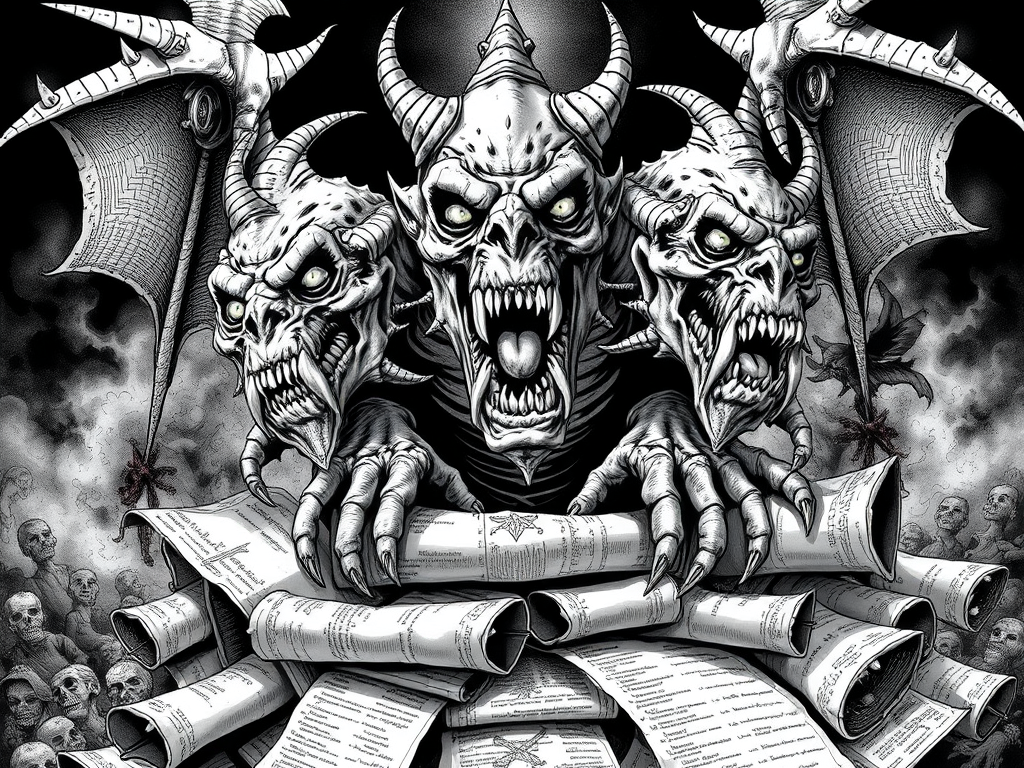
Unfortunately, the American government seems to be trying to do the same with its (so far) excellent universities. Censoring ideas, stifling manifestations. They’re suffocating support, therefore creativity and human development are being impaired. Students’ freedom of expression is being annihilated.
Outside the uni, we led a relatively normal life. Books, music, and plays, when not banned, reached us sanitized by official censors. We opened good news magazines to paragraphs, columns or whole pages of black ink, or pictures that had nothing to do with the text. Bad magazines didn’t show the censored parts, they just filled their pages with more mumbo jumbo praising the government. Journalists and writers, when they did not report favourably on the regime, were at once suspected and accused of communism, Marxism, socialism, terrorism, or any unacceptable foreign ism.
I hope the United States never reach the gutter Brazil did back then: journalists abducted without just cause, tortured, killed, or disappeared without trace, as in the case of Vladimir Herzog and many others. The same could happen to a student, a waiter, a former union leader like Luis Inácio Lula da Silva, who survived prison and torture to become the Brazilian president (for the first time) in 2003. The same happened to economist Dilma Rousseff, another victim of torture and imprisonment; in 2011 she became the first and, so far only, female Brazilian president.
Perhaps the current American administration is more benevolent: so far, we know of stories of journalists falling out of favour and being sent out of the White House press room. Or leaving the Pentagon as they disagreed with the censorship rule for all reporters.
To me, it’s obvious the American government has taken a leaf out of a badly-aged, inhuman CIA book. They have been corralling foreigners in detention centres, without due process of law. They have been splitting families. They have been sending people “back”. That’s what dictatorships do.
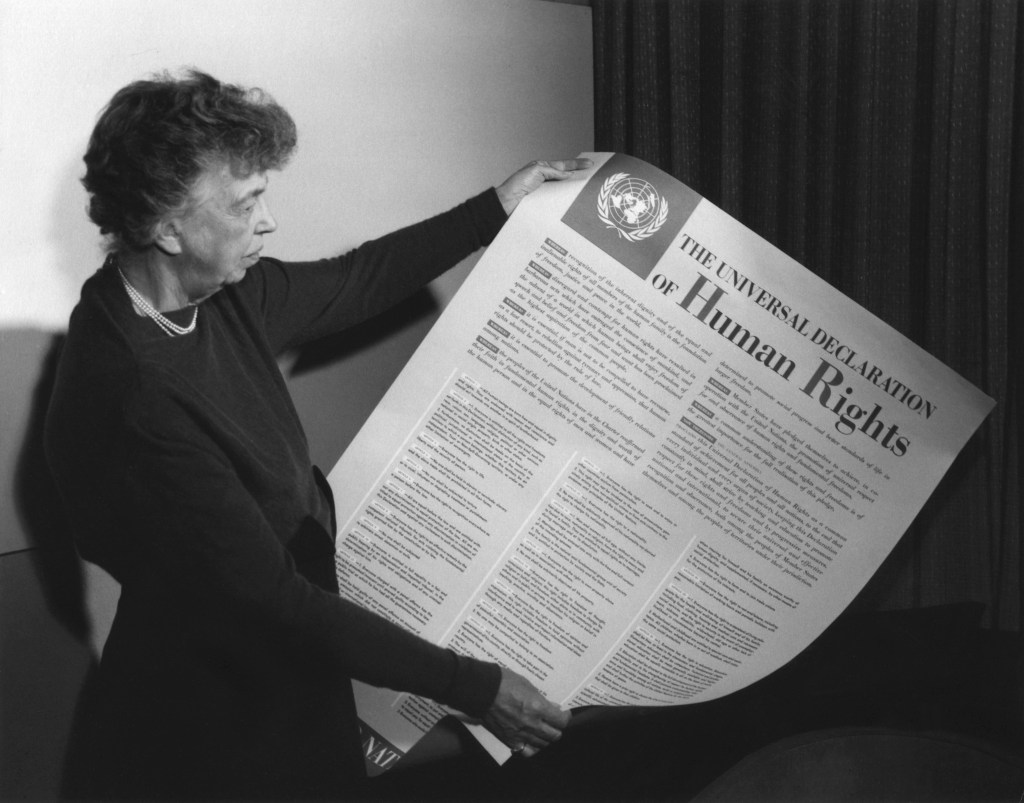
(She beat the Dragon and the Monster) Source
Historically, the Universal Declaration of Human Rights shows the United States under a progressive light. It was drafted by the United Nations’ committee chaired by First Lady Eleanor Roosevelt, whose efforts were validated when the United States became one of the original countries that voted in favour of the Declaration, and led its approval at the United Nations General Assembly in 1948. Brazil also voted in favour of the Declaration.
The Declaration’s Article 9 states,
No one shall be subjected to arbitrary arrest, detention or exile.
Article 5 states,
No one shall be subjected to torture or to cruel, inhuman or degrading treatment or punishment.
As we know, these signed international declarations and treaties don’t mean much to the current American administration. Or other governments, of whatever political inclination, in whatever country, that seem to disguise their wrongdoings and claim they’re more saintly than the pope.
A book titled Brazil, Nunca Mais (Brazil, Never Again) was published in 1985, after the end of the Brazilian dictatorship. The book started as a clandestine work compiled from 1979 to 1985, by Catholic Cardinal Evaristo Arns, Rabi Henry Sobel, Presbyterian Pastor Jaime Wright, and their teams. The book documented over 17,000 victims of torture, and 353 people who died from torture. These were the ones they could find. There must have been many, many more.
Attempts at repression will always generate freedom. Sadly, at great, great cost.
Brazil emerged from its dictatorship with strong democratic roots and ideals. A new constitution was enacted in 1988, guaranteeing citizens’ civil and human rights. Still, that did not prevent Jair Bolsonaro from attempting a military coup in 2022, copycatting what Trump had facilitated in Washington in 2020 (Apparently, one of Trump’s sons was advising Bolsonaro on how to do it; I wonder if he got paid for the hatchet job). The buildings of Brazilian institutions – the Presidential Palace, the Supreme Court, the National Congress – were wounded, but they recaptured their societal worth with common sense, dignity, and the rule of law. It was paper votes against weapons. Paper votes won.
I believe that a network of peaceful resistance will upend what is happening now in America. The “No Kings” movement, strengthened by the grassroots commitment of its participants, was a sight to behold this weekend. It was home-made cardboard signs against machine guns.
I know who will win.
P.S.: I was trying to get OpenAI from WordPress to generate a picture to accompany this entry, so I described a demonstration with lots of people carrying hand-made signs in protest against a king. I clicked “generate” and waited for the picture to emerge. Instead, I got:
An error occurred while generating the image. Please, try again!
This request has been flagged by OpenAI moderation system. Please try to rephrase your post.
And I thought I was free of censorship…
Music of the Rant: Please suggest something. The weirdest the better — I’ll post every suggestion. Thanks!
27/Oct/25 — A kind reader has suggested John Williams’ “The Imperial March”, Darth Vader’s theme from “Star Wars”. In this version, the music icon conducts the National Symphony Orchestra at the Kennedy Center, Washington, DC.
28/Oct/25 — I’ve just received this version of “The Imperial March”, this time played with chickens by Lord Vinheteiro. Enjoy!


 Regina's Rants
2 responses to “Dictatorship Where?”
Right on, write on!
The protest was awesome.
Get BlueMail for Android
LikeLiked by 1 person
Glad you were part of it! Oh joy!
LikeLike