
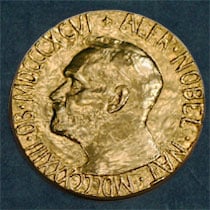
Alas, Nobel Prize season is upon us. This week, from Stockholm, Sweden, the Nobel Committee will announce the prizes for Medicine or Physiology, Physics and Chemistry, Economic Sciences, and Literature. From Oslo, Norway, the much-awaited Nobel Peace Prize will be announced on Friday, 10 October 2025, at 11:00 CEST. The prizes are coveted by scientists, writers, politicians, environmentalists, heads of international organizations, and just about anybody who’s ever done something good for humanity. Or not — we know a guy who wants it bad, bad, bad.
How do luminaries, and at times unknowns, get nominated for the Nobel Peace Prize?
You fill a form online. To do that, there are some rules. First, you cannot nominate yourself, even if you think you’re the most deserving person in the whole world. Second, you cannot nominate posthumously. Third, to nominate a person or organization for a Nobel Peace Prize you must be a very significant person: a head of state, of an international or national organization; a member of the International Court of Justice; The Permanent Court of Arbitration; or The Women’s International League for Peace and Freedom. A nomination will be very well-considered if written by a Nobel Laureate, by a university director, or head of a peace research institute. There are more institutions whose members are considered qualified to become nominators, but the number is slim. Slimmer still is the number of laureates.
The Nobel Peace Prize Committee received, this year, nominations for 338 individuals and organizations. By the Committee’s rules, the names of all nominees are sealed for 50 years. In their view, we get to know who’s the winner, and that’s it. But these days we all know some of the nominees, because first, those who make the nominations must collect their political or perhaps financial dues, and second, the nominees just cannot keep their mouths shut.
In 2019 Trump revealed that he had been nominated for the Nobel Peace Prize by Japanese Prime Minister Shinzo Abe, Japan’s longest serving prime-minister. The importance of this “most beautiful” nomination letter cannot be understated.
The five-page letter had been a well-contained Japanese state secret. But it was let loose by You-Know-Who, so Prime Minister Shinzo Abe was questioned in Parliament, bowed deeply to all, and refused to answer either Yay or Nay. The more he was questioned, the lower he bowed, and the tighter his mouth became. But other people loosened up, and revealed that the request, more like an order, had arisen from the American government. Japan was at the time in the middle of a tiff between North and South Koreas, and the US were threatening to withdraw their military protection. By nominating Trump, Japan would reacquire American military protection.
That’s the way international diplomacy works. A bit like the Mafia, isn’t it?
Why would Japan, one of the largest economies in the world, need American protection? Japan surrendered to the allied forces in 1945, and from then until 1952, it was militarily occupied by US forces led by General Douglas MacArthur, the Supreme Commander of the Allied Forces (SCAF). SCAF worked tirelessly to change Japan’s military and political stances. One of the results was the Japanese Constitution of 1947, and its Article 9, which states:
Aspiring sincerely to an international peace based on justice and order, the Japanese people forever renounce war as a sovereign right of the nation and the threat or use of force as means of settling international disputes.
In order to accomplish the aim […], land, sea, and air forces, as well as other war potential, will never be maintained. The right of belligerency of the state will not be recognized.
Effectively, Japan had no military. However, the Japanese Self Defence Forces (JSDF) was formed in 1954, charged with non-violent international peacekeeping and natural disasters assistance. Through the following decades, Article 9 has been reinterpreted. Only in 2014 did Prime Minister Shinto Abe, through cautious approach, manage to officialise the existence of JSDF and its wide national and international scope.
Meanwhile, in 1950 both nations signed the US-Japan Security Treaty. Its Article 5 commits the United States to defend Japan if it were attacked by a third party. And vice-versa. These days, 55 thousand US military personnel discharge their duties in Japan, distributed in 10 major bases and 110 minor military installations. The bases also employ about 25 thousand Japanese. By threatening to withdraw American troops from Japan because the US were spending too much money on Japan’s security, and Japan was not, Trump the Thug was reneging on an international treaty. Which was probably nothing new for him. But all was not about taxpayers’ money.
The Japanese government covers about 75% of the bases’ expenses, plus outlays such as waived taxes, utilities, and labour cost of Japanese nationals employed in US bases. The US was hardly getting to defend Japan for free, as Trump had claimed.
From somewhere deep in the memory of my misspent days at Critical Thinking class, I recall that the US would be unable to bring all their troops stationed overseas home, currently around 160 thousand. There was no way they could house, feed, pay, and allocate every military who returned home. They’d also have to relocate their top-of the range tanks, aircraft, missiles, and more equipment from overseas and install them somewhere in the country. They could not even afford to bring home all the 55 thousand from Japan. It wasn’t just a logistic and financial nightmare — it was an impossibility.
However, Japan could not work with those assumptions. Not when you’ve signed a treaty of total surrender after being flattened by two nuclear bombs.
All had to contend with the fact that Trump the Thug was not fair either. He squeezed more money out of Japan to cover for the military bases, and, winning air punch! He got a Nobel Peace Prize recommendation to boot.
That’s just one example of how bad diplomacy works. Good diplomacy, though, meant that Trump the Thug did not get the Nobel Peace Prize back then.

Now in his second term, Trump the Thug is still pursuing that elusive Nobel Peace Prize, and all that it entails: prize money (just under US$1 million), which, he will say, he doesn’t need; a banquet with the king, queen, and princesses of Norway and the great and the good of the land, which will give him more bragging rights; a lecture to the same great and the good of the land, in front of the camera which he adores; a golden gong to hang from his neck, because there’s no more room for gold at the Oval’s walls; and a diploma, the likes of which Trump University, in its fakery, was never able to issue.
This second term, the self-entitled President of Peace claims to have stopped seven wars. This claim has been debunked on both sides of the Atlantic and beyond. The man begs for a Nobel Peace Prize whenever he gets within a person’s earshot or near a microphone. It’s a sorry state of affairs.
Still, heads of state from Israel, Cambodia, Pakistan, Rwanda and Azerbaijan have nominated Trump the Thug for the Nobel Peace Prize. American Republican senators, and even a Norwegian law professor have also done so. They must be collecting their international political blessings now.
And I wonder, I wonder, after Trump the Thug’s visit to England, did he manage to get King Charles to nominate him? Or was it left for Keir Starmer or The Thug’s friend Nigel Farage? I have a niggling thought that Bolsonaro has written a nomination, too. That Thug keeps such august company.
If Trump ever crossed the line from being a Nobel Peace Prize nominee to becoming a laureate, he’d be the first Republican president to do so. Others were Theodore Roosevelt (1906); Woodrow Wilson (1919); Jimmy Carter (2002); and Barack Obama (2009). Vice-President Al Gore was a laureate in 2007. Respectively, they became laureates due to their dedication and hard work toward:
– Mediating the Russo-Japanese War
– Founding the League of Nations
– Humanitarian and diplomatic work
– Diplomacy and coalition-building efforts
– Climate change
I wonder what Trump the Thug has done to deserve the Peace Prize itself? Being Putin’s friend? Being heartbroken after Putin hoodwinked him? Squeezing a rare mineral deal with Ukraine with the carrot of peace and never promoting peace? Enabling Netanyahu to raze Gaza and commit genocide? Destroying international aid? Discombobulating the American approach to renewable energy? Denying women’s choice about their bodies? Oh, I despair, there’s so much more that he’s turned negative for humanity. Perhaps there’s hope that Trump the Thug will never win the prize despite all those sycophantic nominations.
Last year, the Nobel Peace Prize was awarded to Nihon Hidankyō, a Japanese organization, “for its efforts to achieve a world free of nuclear weapons and for demonstrating through witness testimony that nuclear weapons must never be used again”. To paraphrase Nihon Hidankyō’s co-chair, himself a survivor of the atomic bomb, he thought that those working in Gaza deserved the prize more than his organization did, and that the situation in Gaza “was like Japan 80 years ago.” You can listen to his Nobel Prize Lecture (in Japanese, with English subtitles), or read the English translation at the Nobel Prize website.
Peace.
Music of the Rant
Mr. Tangerine Man, a parody by the NM (New Mexico, US) Raging Grannies, based on Bob Dylan’s Mr. Tambourine Man. Bob Dylan is himself a Laureate of the Nobel Prize of Literature (2016). The new words are included in the link – sing along and pass it on, even if you’re not a granny.

 Regina's Rants
2 responses to “That Nobel Peace Prize Malarkey”
Awesome sauce!
Get BlueMail for Android
LikeLike
Thanks! All the best to you!
LikeLike