

When I arrived in Jakarta in 1992, Indonesia comprised over 13,000 islands. In 1998, modern aerial surveys revealed a new total of 17,500 islands. The island of Java, where Jakarta is rooted, corresponds to only 7% of the Indonesian surface, but it cradles 156 million people, equivalent to 56% of the Indonesian population. In the 90’s, Jakarta was teeming with a population of about 8.5 million.
That high density population meant land in Jakarta was precious, plots were small, and houses swallowed most of the land. I lived on a minor street in a nice residential area. Houses were surrounded by four meters high side and back walls. Those walls enclosed my house and formed a block against each neighbour’s own oversized boundaries. My low front wall of brick and wrought iron, softened by a row of blousy butter-yellow cosmos that flowered most of the year, restricted the view to and from the street. Partly due to our high boundaries, we were all good neighbours, for we knew where we belonged, and where our rights and obligations stood. Or did we?
My study window framed the lush canopy of a mango tree. From my narrow patch of a first floor front veranda, off the study, I viewed portions of eight other gardens and a good wedge of street. But those extravagant high boundaries could, at times, be off-putting: they channelled all the street noise into the study, especially vendors whose income depended on the advertising ruckus they made.
Those boisterous visitors arrived in waves and encroached into my boundaries and ears as if they were intimate friends. What right did they have to stop by my home and behave as if they had been invited to a party? And how come they talked so, so, so much? Indonesian societal behaviour, complex with its strict hierarchical levels, reinforced community. And community, it’s understood, is strengthened by sharing: food, space, tales, laughter, gossip. Oh, yes, always gossip.
The Day, Vendor By Vendor
AROUND 7 a.m. – Bread Man announces the freshness of his products from the loudspeaker on the roof of his red van, which resembles a mobile display window. His faithful customers include two of my not-so-immediate neighbours. I am told one is the American family whose mother has redecorated her house in Jakarta as a perfect copy of her house in Texas, including textiles and drawer liners; another, the Indian family, has two sons studying at Harvard, and the wife has started a new job to help pay tuition fees (mind you, we were all neighbours, but we never actually met each other). While the transaction with Bread Man goes on, his loudspeaker blasts the still cool air in hope of attracting more customers, who rarely turn up. Then off he goes, driving slowly in search of trade.
BETWEEN 7 a.m. AND THE REST OF THE DAY – Construction workers smash what could be a tranquil spell when they turn on a piercing saw to slice precise squares of whitish marble for the new floor. I’m told the house belongs to someone from the family, that is, from President Suharto’s powerful political family, so I must not complain. It’s an honour to put up with the din caused by such eminent neighbours-to-be. To judge by the length of the work, they must be redoing not only all the floors, but also all the walls and ceilings in marble. In which case the workers are building a mausoleum.
The cacophony is joined by the visitation of cars with faulty exhaust pipes or screeching fan belts, kamikaze bikers, and the peculiar two-piston sputtering from bajajs.
ABOUT 8:30 a.m. – Quiet Vegetable Man passes in front of my gate, knowing he is unpopular in this patch. He looks sly and questioning, as if he were trespassing. He is. Local lore mentions him as the loser in the territorial fight against the Real Vegetable Man. How and what really happened remains a mystery to me.
ABOUT 9 a.m. — Real Vegetable Man, smiling due to his dominance in this part of the borough, parks his blue cart piled high right under the shade of my mango tree, which hangs over the footpath. I buy a bunch of meter-long string beans, and the unmissable ingredients for sambal, that lethal sauce: heaps of red chillies, plump ginger, shallots, garlic, limes, lemongrass. I stock up in eggs and tofu, and a bouquet of magenta orchids.

Real Vegetable Man is popular. He provides, between the pricing and bargaining going around, the midmorning break for cooks who get to know the latest gossip. Nannies and their charges on pushchairs, and men on their bikes stop by. Their chatter used to be a nuisance. Compared with the uproar of the saw nearby, now I find my morning is incomplete without their good-natured jests.
WHEN REAL VEGETABLE MAN IS ABOUT TO LEAVE – Snack Man, the purveyor of vegetarian fast food, turns the street corner. He is thin and bent under the thick bamboo pole across his shoulders. The pole arches down, pulled on one extreme by the weight of prepared sweet potatoes, bananas, cassava, batter and utensils; on the other, a small gas bottle under a wok two-thirds full of hot frying oil keeps Snack Man’s balance. He rests his makeshift stove to the right of my gate and smokes a clove cigarette while he awaits a customer.
AT 9:45 a.m. SHARP – Piano practice starts. That’s the neighbour to the back, whom I have never met, the one who had allegedly found his wife sharing their new four-post bed (decorated with new pink sheets, drapery, and ostrich feathers) with his best friend. The neighbour creates conflicting notes that bounce around neighbourhood walls, from what I imagine to be a grand piano attached to loudspeakers of gargantuan output. I have never identified what he plays. Versions of Strangers in the Night and Pour Elise, are, perhaps, just musical coincidences. Maybe he just bangs on the keys to get the wife out of his system. Perhaps he is a composer, but his music requires erudite ears and a willing heart, none of which I own.
WHILE PIANO MAN PLAYS – Toy Vendor announces his arrival by squeezing different toys that yield irritating squeaky sounds. He rides an old, battered black bicycle and lodges his back against a two-meter stack of fully inflated duck buoys, multicoloured balls, smiling bears, Mickey Mousse, He-Man, and whatever or whomever a child could wish for in inflatable form. Business for his articles is slack in the street, which is a reason for him to increase the frequency of his clamours above the squeak. I hope for harmony between piano clatter and strident toys, but no such luck.
ABOUT 10:30 a.m. – Lunch time for those who wake up for prayers at four in the morning (about 97% of the population). Several food vendors compete for serious business. Their numbers vary daily, but a tropical buffet spreads under and around the shade of the mango tree: noodles (fried or boiled), chicken or baso soup, vegetables with peanut sauce, fried rice, skinned and sliced pineapple, papaya, watermelon, green agar-agar jelly in coconut juice, warm soft drinks, and slush cups topped with garish syrups.
Each vendor announces his specialty in his own way. Brass bells, wooden drums, and small gongs work just as well as clinking spoons against glasses and generalised hollering.
Curious drivers slow down at the commotion, which reminds them it is their time to eat, too, and eating is best done in genial company. Their voices dance in the air to reach me with their different accents and intonations. They squat by the kerb, bowl in one hand, chopsticks or spoon in the other. It doesn’t take them long to finish, for they are hungry and the portions are on the small side. They stay on for a natter.

When most customers are gone, Noodles Man uses my garden pipe to refill his washing bucket. I fear I might be contributing to the spread of disease. I reason, Noodles Man has been doing this for years, and he wouldn’t be still doing it if he had caused any health upheaval. In Jakarta, water is worth its volume in gold, so I let it go.
Then I notice Noodles Man’s long pinky nail. Long pinky and thumb nails are cultural symbols, as in, it’s common in his village, and they denote someone who is not a manual worker. Again, I think contamination, for in certain Indonesian places, it’s forbidden to smoke, but it’s acceptable to pick your nose in public with your long pinky nail. That’s what it’s really for. Once, and once was enough, I found myself in a sticky situation when a birthday party guest picked his nose with his pinky, flicked the trawl of gunk to the side, and then grabbed my limp hand in effusive greeting.
FROM 11:30 a.m. TO 2:00 p.m. – Heat and humidity reach a peak. It’s nap time. It’s also garbage collection time.
Garbage collection is a highly specialised business aided by an architectural blunder plonked at the right end of my front wall. From the inside of my small garden, blunder looks like an oversized box painted white many years ago. It sports a rusty iron doorlet, whose edges have been nibbled by time. At the street side, there’s another door, larger than the one inside, made of the same iron, rusty and mostly devoured by careless use. You use the inside doorlet to deposit your daily garbage inside a strong plastic bag. Then, in hierarchical order, refuse collectors rummage through your garbage from the outside door.
First in line is Plastic Man, who rips the plastic bag with his professional tool that resembles a rusty trident. With the precise movements of a brain surgeon, he prises the plastic bag free, hooks it, and drops it in his cart. He probes the garbage for more plastic stuff, or anything with the semblance of plastic. His best haul, according to my intermittent observations, includes two broken white chairs, four gigantic water bottles, and heaps of debris that could have been jetted from a demolition site or a riot.
The bin doorlet remains open for Metal Man. He mines the garbage, and usually doesn’t find much. By then, the bin is in a total state of disarray.
Paper Man is next, followed by Anything Else Man. These approach in a van whose back has been adapted as an oversized rectangular press ready to squeeze increasing amounts without spilling or whining. Two men control the intake, standing on top of the open van, distributing and stomping on what is thrown in.
Sometimes the order of collection is altered without explanation. Or one or another collector fails to appear altogether. This creates the problem of a permanently open door, which is difficult to close after contents have been spilled and scrambled. The bin, I am told, becomes the teeming meeting place of flies, dogs, cats, rats, and snakes.
Some people are unaccustomed to such omnishambles. Since every house in the neighbourhood has a bin in similar condition, after a while nobody notices them. Or pretend they do not. When a new-arrival vents, “Have you noticed the smell?” community mores demand the answer, “It’s Chanel no. 5.”
ABOUT 12:30 PM – The only female vendor appears in the form of the Jamu Woman, the medicine woman, who arrives wrapped in a sarong and a gaudy blouse, and sports the glossiest long black hair I’ve ever seen. She sells herbal concoctions supposed to cure everything from pimples to impotence, passing through exhaustion, migraine, and hot bellies. The Jamu Woman’s regal walk disregards the weight of eight or nine large glass bottles in a basket strapped to her back with a batik cloth. Each bottle is full of mysterious liquids. Her hand swings a red plastic bucket brimming with water and glass cups. She walks by and her only sound is that of flip-flops against her heels. In her dignity, she needs no loud advertising.
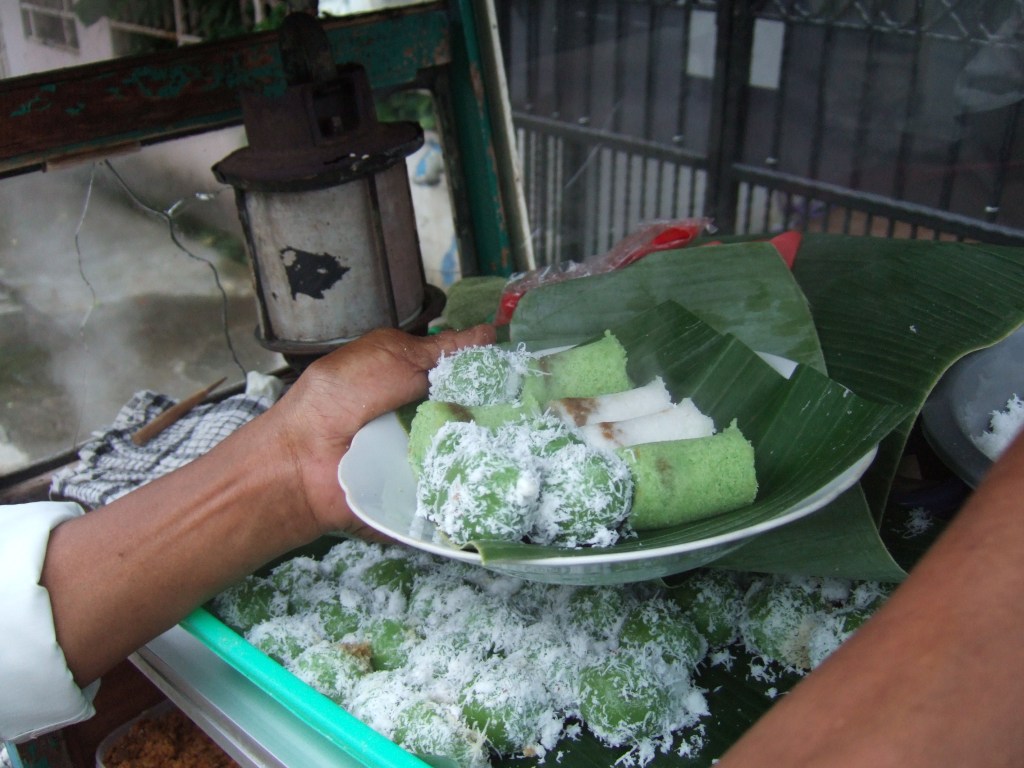
THE AFTERNOON – Claims cakes and sweets. Steamed Cake Man doesn’t hold my favour. But when the steam-powered whistle of Kue Puto Man pierces the air in my study when he’s still two streets away, I dig in the drawer for change, give it to my youngest, and he waits at the gate. He returns with a banana leaf delicately folded into a bowl and we share steaming green cylinders of rice flour with melted brown sugar centres, the lot sprinkled with fresh coconut flakes. It’s steamed, so it’s safe to eat, and Kue Puto Man does not have a long pinky nail.
SOMETIMES DURING AFTERNOON BREAK – We eat kue puto to Arabic music adapted to Indonesian tempo. Cassette Man, who defies Copyright laws because he sells copied music tapes, parks his cart topped with a glass case vibrant with hundreds of tapes. The songs that blare out of his sound box summons not only buyers and half-deaf listeners, but also my high level of tolerance.
FROM 4:30 PM ON – House cleaning tradition dictates that cleaners gather leaves and twigs fallen in the garden and their part of the street. Due to garbage collectors’ dictum that leaves and twigs are not their responsibility, servants keep face and peace. Once dumped in the garbage bin, leaves and twigs get mixed with whatever leftover refuse a house has that day. Then the whole lot is set alight.
My home owes something to joss or Feng Shui in its splendid ventilation. Accosting from all directions, the harsh smoke of burning wood, plastic, rotten food, old newspapers and more, much more, drifts up the mango tree and invades my study. Gone, and I hope forgotten, is the day when I, a newbie to local customs, became the street’s comic relief: I thought the house was on fire and tried to jump from the veranda.

EVERY TWO WEEKS, USUALLY ON A THURSDAY – My neighbours to the left (allegedly a couple with no kids although they desire them very much, but she can’t have babies) have a professional company fog their back and front yards during the dry season. During the rainy season they do it once a week, in a desperate attempt to prevent an epidemic of dengue haemorrhagic fever arising from their minute plot of land. Three Company Men dressed in sterile white overalls, long sleeved shirts and white head scarves which they use to cover their faces, arrive in a suspicious, unmarked green van. Van Driver retreats to the opposite side of the street to smoke his clove cigarette. Two Application Men prepare a lethal mixture which they feed into what looks like an oversized machine gun. Its motor coughs loudly and sometimes needs to be fixed before it convulses constantly enough to retch a dense cumulus of poison.
While the men fix the motor, I put into effect one of my emergency plans. I close all front windows and doors, which otherwise are open from morning until bedtime. I turn on four standing fans on full blast, facing the back of the house. On a small scale, this forced ventilation system diminishes unwanted chemicals. But the eerie greyish vapour envelops my mango tree and the deathly infusion saturates newly formed leaves and fruits. And I wonder if this chemical has, somehow, affected the neighbours’ procreation plans.
ONCE A MONTH OR SO – The sedate neighbour to the right (who lives alone in a six-bedroom house because his Japanese wife left him due to his drinking) breaks the street’s relative peace by having his sewers cleaned. Nobody else in the street has sewers cleaned that often, if ever, so I imagine that either his is a badly engineered sewer, or his sewer might in fact be overflowing with refuse from all other houses in the street, in which case we’re all in his debt.
A lorry with a huge black cylinder looms by the neighbour’s front gate while the crew attaches thick flexible tubes to a hidden part of his land. When the pump aspiring waste from land to lorry kicks in, my house vibrates as if possessed by supernatural powers. My computer screen blinks, and I think it’s a form of exorcism.
Sometimes, as it must happen, the pump breaks down and the lorry parks at the gate for a whole day, to finish the job at dinner time, for everyone’s distress. Once, the tubes suffer uncontrollable damage and sewage gushes down the street. The news and the stench spread around quickly and, knowing that my street was no fun place to be, all street vendors disappear. Withdrawal symptoms set in, I can barely cope with the alien silence, so I sprint to a local restaurant for a boisterously therapeutic dinner.
SPORADICALLY — A dog fight erupts late afternoon, when servants walk employers’ overindulged, groomed doglets, or professional dog trainers wobble after vicious-looking beasts. The latest fight occurs among Poodle, Pekingese, Mongrel, Lassie, and Doberman. Dogs bark, howl, growl, and jump in different directions. Screams call my attention first. I imagine a ferocious dog had bitten a mouthful off someone’s limb. I prepare to take someone to the hospital.
It turns out that seven people are having a jubilant time. The person not having a good time is Poodle’s owner, the woman with hysterical screams. She screams looking at her hands outstretched over her head, wails while holding her belly as if in pain, squats, wails again, and suddenly raises herself as if gathering momentum to start another cycle of screams.
The dogs’ fury is incited by the unreachable, plump black rat inside a wire cage. The trap looks familiar, but in the interest of community well-being, I refrain from asking, “Who let you have my rat trap?” There are certain things a person does not ask in front of witnesses.
A gardener, who works for the couple who every other week produces a show of jealousy by smashing all the plates in the house, detonates a jet of water from a hosepipe and targets one dog after another. That diverts their attention and gives trainers time to find lead ends and pull their dogs apart from each other and from the rat. It’s a merry hour again.

ONCE –Labourers break my peace from the opposite side of the street, the house that belongs to the Philippine couple whose wife was so homesick that she cried every day for the first three months in Jakarta, until they went on holiday to Disneyland in California and she returned cured (there are worse places than Jakarta). Labourers arrive with multi-dimensional saws, ropes and pulleys to cut down a banyan tree that was overtaking the small garden. But then once is just enough to cut down a majestic tree.
ONCE AGAIN – My first earthquake, a 6.8. Pre-menopause is playing up, I think, but then I hear the glass window slats trembling and clinking like champagne glasses, so I dash down the stairs and am hurled this way and that, as if something uncontrollable had taken over my body. I reach the garden to be thrown around, and there’s no end to the great rumbles. I wait. When shakes and rumbles finally stop, a great silence rises from the belly of the earth, and, for a split second, I think there’s a new world around me. But no. House, boundaries, and street, look just the same as before.
EVERY EVENING – A sliver of sun insinuates itself from the veranda door into my study, and stretches itself to lick the back of my hand at the keyboard. As auspicious as it seems, the disappearing sun heralds a cloud of hungry mosquitoes that defy sprays and poisons.
FULL MOON WEEK – I grab a mug of sweet tea, head to the back veranda, and wait for the moonrise above the piano player’s back wall. The moon is not fully risen when the smell of satay roasting over charcoal invades my solitude, and announces the stream of food vendors carting delights throughout the night.
Update
Today, Jakarta has swollen to 11.1 million inhabitants, more than the total population of Portugal. In a flight of fancy, I used Google Earth to find my old house, and found it still painted bright white, behind a new solid front wall and double gate. The mango tree and the cosmos flowers are gone. The garbage bins are now proper containers in different colours, akin to those found in England. As a result, the street is clean.
Trees from both sides of the street meet in the middle to form a tall green guard of honour, and instead of sidewalks, there is clipped grass. Pedestrians, if any, must walk in the street. It’s an enclave in a rough metropolis.
Google Earth has blurred the images of some of the houses for their owners’ privacy. They’re probably owned by the family, whichever family it may be these days. A barrier at the entrance of the street stops the great unwanted from approaching what could be thought of as an exalted space.
My former house and its street are now constrained by boundaries within boundaries within boundaries. The whole lot seems sterile and boring.
I’m glad I lived there when I did.
Double Music of the Rant: Danish pianist Victor Borge in his medley, and his interpretation of the Dance of the Comedians (Smetlana), both from YouTube. Please put up with the initial ads, which have nothing to do with me, but they do make less noise than street vendors in Jakarta, and they’re short.


 Regina's Rants

You must be logged in to post a comment.