

Who hasn’t believed in the supernatural power of a black cat as bringer of bad luck or a rabbit’s foot as saviour from unfortunate events? These beliefs hark to when the supernatural could not be explained, when a person fought one myth with another. With galloping developments in the sciences, and computer access, I’d expect people to act more logically. But these beliefs are so ingrained in the human psyche that we have not only adapted them to our daily lives, but also invented some more. Take the practice of rubbing statues to attract love, money, health, or whatever people covet the most. That’s when the mystical connects with the divine, the absurd, and the profane. Perhaps they are all the same.
The Man with the Keys
The first time I saw a statue being rubbed I was at Saint Peter’s Basilica in the Vatican. I visited the basilica out of curiosity, not devotion. A lengthy and constrictive line of four to five people abreast shuffled into the crowded nave. I didn’t know where it was headed. I went with the flow, distracted by the vast construction and its marbled beauty, and the faint scent of incense mingled with some people’s less than holy odour. The line doddered at a pace similar to the construction of the basilica, which started with Pope Nicholas V (1447-1455) and finished 20 popes later, with Innocent X (1644-1655). You have to respect their perseverance. After all, the popes had the deepest pockets and contracted the most gifted architects, sculptors, and painters of the Renaissance. Still, it was traditional for popes to bargain with artists, and for artists to complain about their paltry wages compared to the great work they had to create and execute.
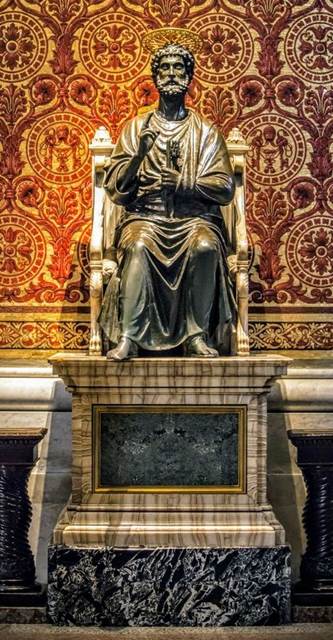
Saint Peter’s bronze statue is probably the original crowd-puller. It was cast in the 12th century by Arnolfo di Cambio, and sits on a carved marble throne atop a marble pedestal, all muted colours against an intricate wall mosaic in red depicting papal symbols and floral motifs. Saint Peter’s feet are at the pilgrims’ eye level, more or less. Each pilgrim was forced to look up to the effigy’s face to implore a miracle. The First Pope held his symbols, the two keys to heaven, and I wondered why heaven was ever locked up, and how many keys a saint really needed. Then I recalled one of Saint Peter’s sayings, “Live as free people, but do not use your freedom as a cover-up for evil.” Maybe that’s worth one of the keys.
The line miraculously turned into a single file as it approached the effigy. People seemed to understand that each person needed or had the right to a few seconds of privacy with Saint Peter’s foot. Each pilgrim kissed Saint Peter’s right foot, and I realised I, too, was in line for the kissing without a way out, without any words of advice as to the protocol. Should I disinfect the kissing area with hand sanitizer? How would the bronze react and – was it even allowed? Wipe it with wet tissue? Trust the supernatural to keep me healthy? I had not signed up for that.

Upon inspection, Saint Peter’s right foot had lost its definition and looked like the end of a baguette. Its sandal had also disappeared due to over-rubbing. The left foot wasn’t in such good shape either, but at least you could count the toes. Millions of pilgrims had filed past the effigy, touched its foot, and pleaded for health, money, absolution. Not wanting to seem disrespectful (To whom?), I touched Saint Peter’s right foot.
I confess I wasn’t open to receive Saint Peter’s blessings that day. I was already blessed that I didn’t carry the weight of a pressing problem or a vital request. Observing the pilgrims’ fervour and their devoted prayers, their hasty signs of the cross, I wondered whether they had unburdened themselves and left their problems at Saint Peter’s feet for him to sort them out, or if they had indeed received some saintly strength to solve what afflicted them. I wished that, one day, they wouldn’t fall into a sorrowful, hopeless, “It’s God’s will.”
Love, They Say
Once upon a time, a Genius who lived in the city of Verona suffered a brainstorm: transform a house’s courtyard and its first floor balcony into a shrine for Juliet. That’s the Juliet of Shakespearean fame, she who tumbled into dramatic plays, films and derivatives that lauded two underage teenagers who had had sex and poison and died, and generated buckets of tears from their audiences. “Let’s get some more tears in,” said Genius.
I balked at the idea of visiting Juliet’s house. I had overlooked it in the description of the small group day trip exploring the Veneto region of Italy. Unfortunately, I was the minority among four explorers. The others were a middle-aged couple in the first (or last) thralls of their relationship, and Husband.
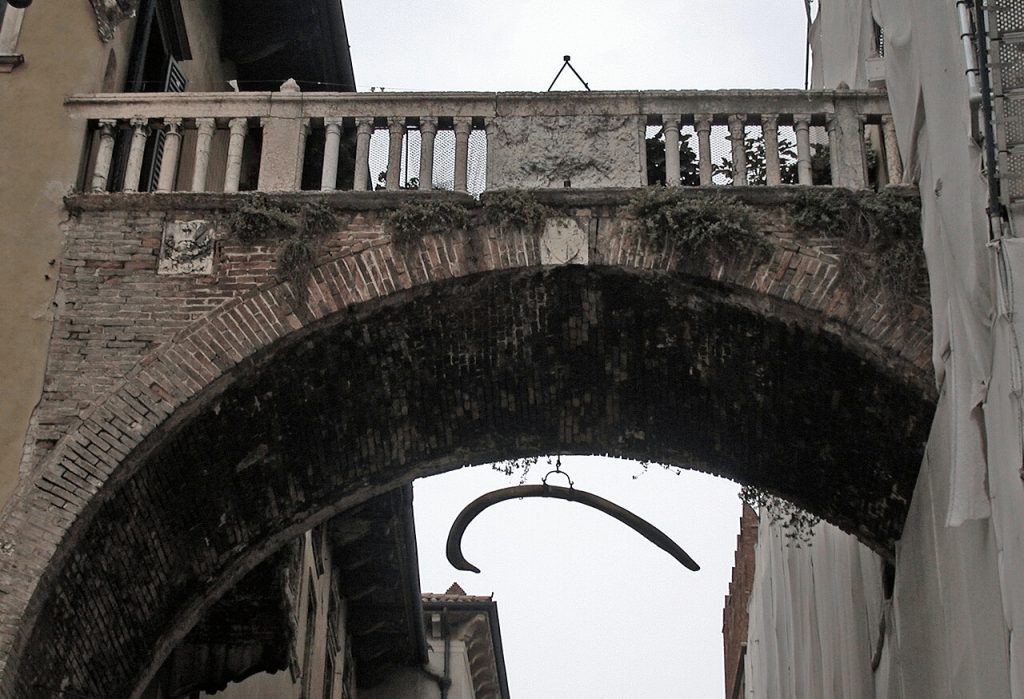
On the way to Juliet’s house, we passed under what looked like an abstract sculpture held aloft by a chain under an arch between two buildings. Above the arch rested a passageway that connected the former city hall to the magistrates’ court. “They say,” said our tall, elegant guide as he pointed at the swinging object, “that’s a piece of whale. A whale rib. It’s been up there since the 17th century. They say that whenever a couple passes under that whale rib, they will stay together forever. And it will fall on the head of a person who has never spoken a lie. Or on the head of a virgin. It has been waiting to fall for a long time, because everybody is a liar and virgins are in short supply these days, they say!” We grinned and pretended to admire the object and think of where it came from. “Nobody knows where it comes from. Could be a present from a knight templar. But it comes from a whale. They say.” It was not his responsibility to be accurate. As we passed under it, the lovey-dovey woman looked at her partner and said, “I want our love to last forever!” But the man got scared by such a big ask. He shook his head, which for me meant a “No!” and then he whispered, “Yes,” and dashed from under the whale bone lest it fall on his head. He was safe, because his truth was unspoken.
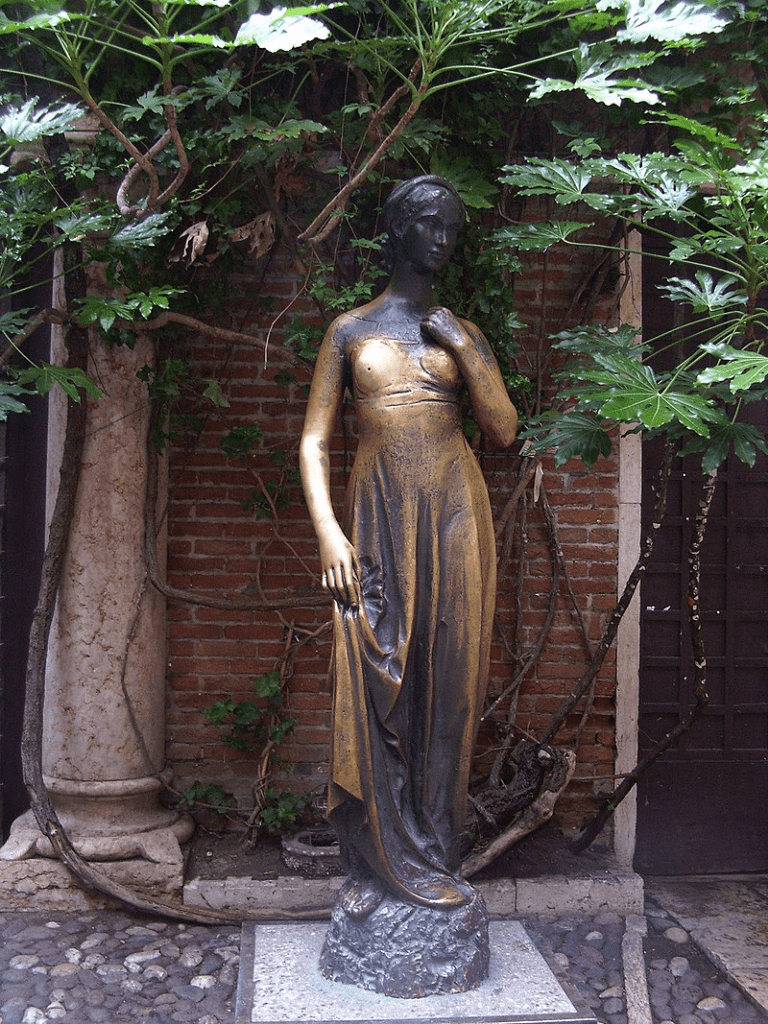
Juliet’s courtyard was packed with tourists sweltering in the last days of the Italian summer. Most coveted a reward from Juliet’s good vibes. Juliet’s life-size bronze statue, due to (mis)handling, had turned shiny golden all over, especially her breasts. They say that fondling Juliet’s breasts will bring the fondler untold, glorious luck in love. Let’s face it: it didn’t for either Juliet or Romeo. It occurred to me that Shakespeare could have invented something like that, charged admission, and not died in penury as he did.
But this statue made by sculptor Nereo Costantini dated from 1968, a little later than Shakespeare’s time, and had already been showing signs of distress – what woman wouldn’t when she’s pawed all day, every day? Juliet’s right breast was cracking. Verona council, ever so hopeful , inaugurated a new replica in 2014.
A gate smothered in red, pink, and gold padlocks offered a distraction from Juliet’s breasts. I was surprised that our tour companions did not add to the messy symbols of a forever love. Then there was the wall of love letters. Visitors read the details in the letters, some made loud comments, others lowered their heads in empathy. But the juvenile demonstration continued: men circled Juliet and almost dribbled as they ran their hands over her arms and hips, and mauled her bronze breasts, hot under the sun. Their companions took photos of their imbecilic faces and hands.
The lovey-dovey couple approached Juliet, he half-stretched his arm, and she went on the attack, “Don’t you dare!” He shrank his shoulders, crossed his arms as if protecting himself, and stared at something in the sky. He was asking for a miracle.
It would have been a treat if an actor had appeared at the balcony and regaled us mere mortals with one of Juliet’s soliloquies, either in Italian, English, or any other language. It could have been,
Come, gentle night, come, loving, black-browed night,
Give me my Romeo. And when I shall die,
Take him and cut him out in little stars,
And he will make the face of heaven so fine
That all the world will be in love with night
And pay no worship to the garish sun.(W. Shakespeare, Romeo and Juliet, Act 3, Scene 2)
But no. The crowded, cage-like courtyard was just that with polished bronze boobs thrown in, and as tourists, we had the moral, philosophical, and monetary obligation to have a good time. Husband’s eyes met mine and we sniggered at the stupidity around us. How did we get into that muddle?
The Princess and her Suitors
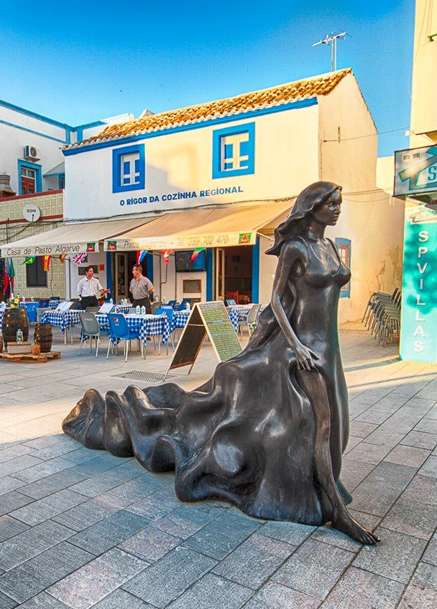
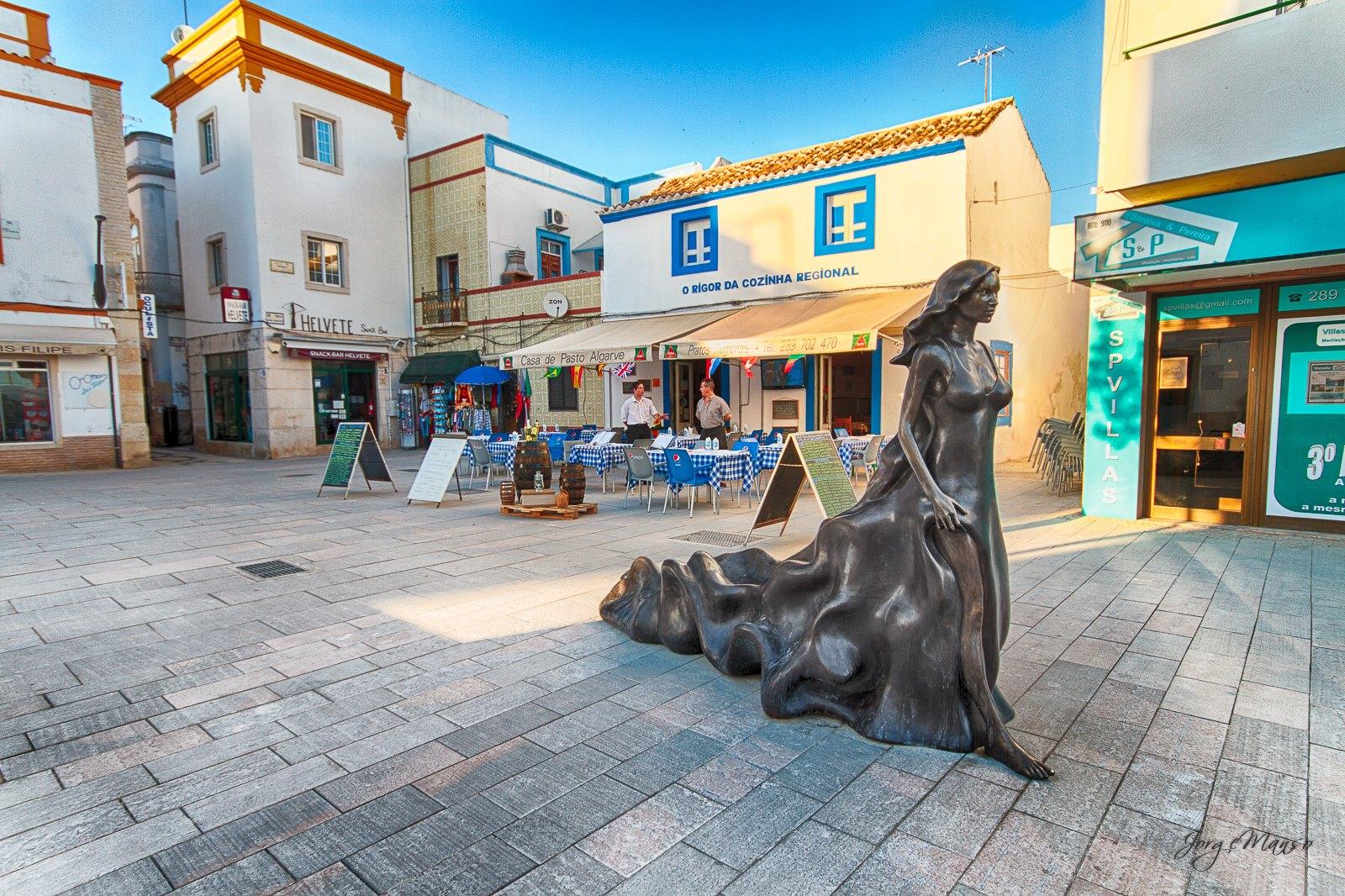
Competing with Juliet, but without her claim to international fame, is the bronze statue of Floripes, which stands near Olhão market, in the Algarve. She is, they say, a Moorish woman, sometimes upgraded to a princess, according to who tells the story. Her father and boyfriend were exiled to Morocco centuries ago, and they were cruel enough to leave her behind. Floripes is described as a blonde who wears a flowing, long white gown that signifies her purity. She will wait for her boyfriend until the end of time. Maybe.
Showing the cruel streak inherited from her father, Floripes spends her early mornings tempting fishermen to cross the Olhão lagoon and the ocean to Morocco carrying a candle, just to bring back her boyfriend. If they managed to do so, they’d earn her heart. (Is it weird that she’d keep the two guys?) If the fisherman didn’t bring back her beloved, they’d die in the sea. These days the legend says that her boyfriend died in a shipwreck, and now she waits for her father to come and get her.
They say Floripes likes shopping. She sometimes paces the town and visits a shop or two. She pays for her goods, whatever they may be, with a gold coin, and leaves without collecting her change. Allegedly, that’s why shop owners in Olhão forget to give you change. Blame it on Floripes.
Floripes’ statue was made by artist Leonel Moura, and was inaugurated in 2014. The statue stands directly on tiles, and displays a good amount of what would have been flesh and feet in a most un-Moorish way. The part of the statue that shows the most wear is the back, for children like to climb and slide down the long, wavy train of her dress. But her breasts have been turning a little golden, a sure sign that people have been rubbing them, although not in enough numbers to crack any of them. Yet.
So far, Floripes’ statue has not been linked to any lucky event for those who rub it. The statue is too fresh. Perhaps Floripes will prevent Olhão from being decimated by an earthquake, a tsunami, or both? Or she could help dark art practitioners to get rid of incompetent, undesirable people unable to cross an ocean carrying a candle. Or it won’t be long before they say, “Her boobs attract love. Money. Sex.”
The Piglet
Here comes another Italian symbol, the wild boar at Florence’s Il Porcellino Market. Il Porcellino is a supernatural entity, one that transforms itself into a handsome young man during the night. It’s a truth universally acknowledged that a handsome young man must fall in love with a beautiful young girl, and vice-versa. Things reached a stage when Il Porcellino wanted to marry his beloved. In the interest of full disclosure, Porcellino told her that during the day he moonlighted as a wild boar, which is a totally normal thing to do, as it’s sure to trigger that frisson of irresistible allure – what woman doesn’t dream of marrying a wild boar? He also made his beloved swear to secrecy about his magic charms, otherwise he’d turn into a wild boar permanently, and they’d never see each other again.
Did she keep Il Porcellino’s secret? Of course not. Il Porcellino remained a wild boar forevermore.
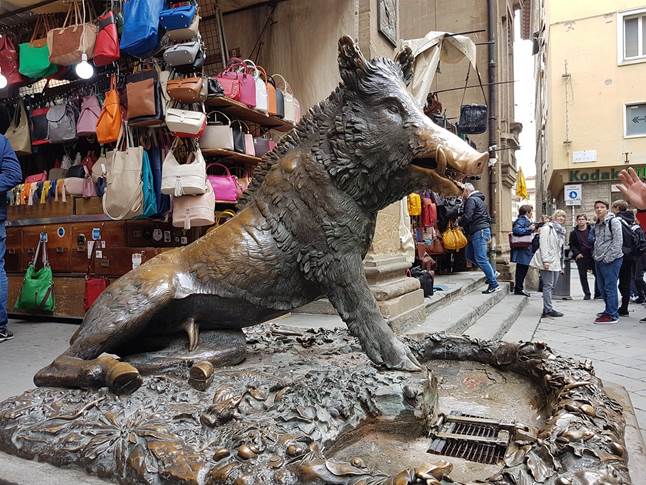
The original Porcellino, a Greek-style marble statue, was stuck in a fountain in Rome. Then Pietro Tacca made a bronze copy in 1612, and it now resides in the Museum Stefano Bardini. The current statue is another replica made in 1998 by Ferdinand Marinelli Artistic Foundry. Il Porcellino sits lopsided on his haunches among stalls heaving with multicoloured leather handbags, wallets, gloves and belts, silk ties, and pashminas all made in China, no, no, sorry, they say it’s all made in Italy. Really.
Never mind that a wild boar is a vicious animal that destroys everything in its path, including humans. Il Porcellino also signifies abundance, and will grant you good fortune when you rub its snout, or place a coin on its tongue so that it slides into the fountain grill at his hooves. (Is he the original money down the drain?) But just like in Juliet’s case, some people think rubbing his snout is not enough, so they rub his back, hooves, and penis to cover all bases. Just in case.
The Charging Bull
Wall Street has inspired many films and books, and their (in)human characters. It also inspired The Charging Bull, another animal, this time with a recent New World history. The bronze sculpture stands at 3.3 meters high, and weighs over 3 tons. Its creator was the Italian sculptor Arturo di Modica, who financed it himself, to represent the second oldest profession in the world: the traders of a bullish market. No, no. After the crash of 1989, the artist wanted it to “celebrate the can-do spirit of America and especially New York.”

Sometimes artists don’t pay attention to paperwork and permissions necessary to install their artworks in public places. One day in 1989, di Modica thought the bull’s sculpture was ready, so he gathered some friends and they popped the bull on a lorry and took it to the New York Stock Exchange Building, where they dropped it unceremoniously without so much as a by-your-leave. Sometimes this attitude is called Guerrilla Art.
Alas, Guerrilla Art was not acceptable then in NYC. The police intervened, the bull was removed within a day, and repositioned two blocks down, at Bowling Green. It didn’t take long for it to become a tourist attraction and create its own myth.
They say the bull offers great abundance to those who rub its testicles.

One thing is for sure: due to the bull becoming such a landmark in New York City, di Modica made different editions and some private commissions of large, charging bulls. For instance, the platinum bull, which apparently was not finalized, was reputed to have cost US$ 12 million. At least for di Modica it was worth it to rub the bull’s testicles.
Noir Desires
Unique in this rant, this guy Victor Noir, nom de plume of Yvan Salmon, was real. He was a fearless journalist in 1870 who faced up to Prince Pierre Bonaparte, cousin of Emperor Napoleon III himself. Noir’s boss had written an unenthusiastic article about the original Napoleon Bonaparte, so he was challenged by Prince Pierre to a duel, which was how they sorted things out back then. Noire was one of the two duel seconds and both tried to speak with Prince Pierre regarding essential details: time, place, weapons, picnic basket, etc. Prince Pierre was incensed that he had been sent the lowest of his rival’s minions to disturb him at home. By royal protocol, them plebs should be talking with Prince Pierre’s minions. Again, Noir dared to address Prince Pierre, who felt even more insulted, pulled out his pistol and shot Noir, who died on the spot.
The event was poignant: Noir was 21 years old, and he was supposed to get married the next day. But Noir became a hero of the free press. By some accounts, over 100,000 people attended his funeral in Neully, his hometown. The sentence, “I/he/she attended Noir’s funeral,” became the sign of a politically engaged, trustworthy individual.
Noir’s remains were moved 20 years later to the prestigious and densely-populated (70,000 and counting) Père Lachaise Cemetery in Paris. Immortality is never assured, but if you’ve made it to Père Lachaise, you have made it in this world and the next. Your life will be forever scrutinised and remembered, which is seldom a good thing, but you can’t have everything. Noir counts among his silent neighbours Oscar Wilde, Edit Piaf, Frédéric Chopin, Maria Callas, Camille Pissarro, and many former stars. Jules Dalou, a famous sculptor, was tasked with creating a bronze memorial sculpture to liven up Noir’s grave.
I think it went like this. Dalou channelled Noir’s supine position at his death, including the position of his top hat beside his leg. From his research for the creation of the sculpture, Dalou must have been inspired by Noir’s most courageous stance when he challenged a high member of the authoritarian imperial regime. It meant that Noir had cojones, so Dalou had to show that in his creation. But cojones are notoriously difficult to represent on a supine body, so Dalou bestowed upon Noir’s life-size statue a respectable, and by now renowned, erection.
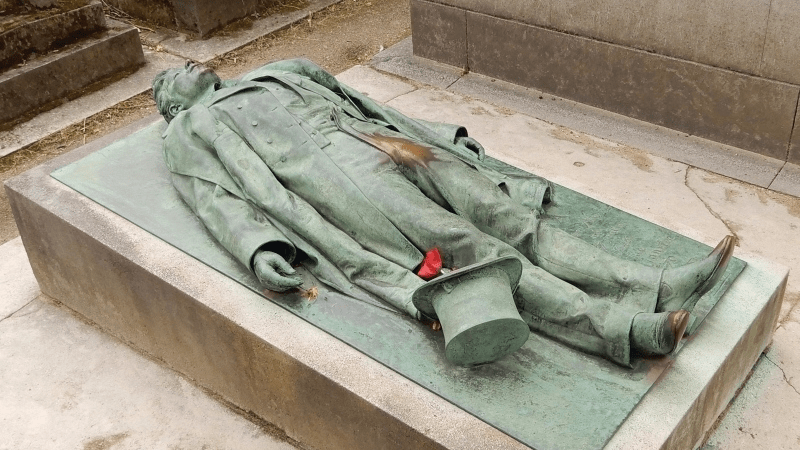
It started in the 1970’s. Women who wished to conceive visited Noir’s tomb and performed a peculiar ritual: placed flowers in his hat, kissed Noir’s lips, and rubbed his larger-than-life penis. Conception was certain. They say. If a woman didn’t wish to conceive, but still wanted a husband and/or a very active sexual life, she just kissed his lips, which accounted for the layers of lipstick left behind after the bizarre ritual.
After aging for over a century, Noir’s memorial sculpture is now enveloped in its unique verdigris. It shows, also, signs of burnishing on the lips, crotch, and shoes (perhaps a sign of visitors’ shoe fetish).
In 2004, an iron fence was constructed around Noir’s tomb to prevent not only the lustful demonstrations of prospective mothers who rode Noir’s effigy, but also to preserve the statue which was showing signs of material stress – something like crotch rot. Noir’s most prized section was cracking under pressure.
But what do we know. Another Parisian journalist, Péri Cochin, started a movement to remove the fence in the name of “the female population of Paris”, because it was assaulting their basic rights. The fence was taken down.
Around the world, there are countless other symbols that get rubbed for good fortune in love and money. It’s all harmless fun. Or not. Regardless, I wish you good fortune. But you know what they say: there’s a reason astronomers never look for intelligent life on Earth…
Music of the Rant:
La Vie en Rose, sung by Edit Piaf. Composed by Edit Piaf, Louiguy, and Marguerite Monnot. Check it out at Bing Videos


 Regina's Rants

2 responses to “Rub It In: Love, Sex, And Money Luck”
Such fun!
LikeLike
Thank you! If you liked it, please share it with your friends. If you didn’t like it, please share with your enemies. Best!
LikeLike