

The Bay-Tree Egg, 1911. Source
In 1685, the Huguenot family Favri left Picardy in France because of religious persecution, and settled in Pärnu, today’s Estonia. Back then, they had no idea their descendants would reach great recognition and their works would be admired in European courts and beyond. This is a family that has survived persecutions, revolutions, conglomerate takeovers and mergers, and has come up again and again, as we all know, throwing eggs on everyone’s faces.
Through the centuries, the original Favri family name has turned Favry, then Fabri, Fabrier, Favrier, and penultimately, Faberge. In the 1840’s one of their descendants, Gustav Faberge, decided to do his apprenticeship as a goldsmith in Saint Petersburg, and his exceptional skills led him to finish his training at Keibel, jewellers to the Russian emperors. After a while, Gustav decided to open his own shop, and he changed his surname to Fabergé – that accent aigu made all the difference, I suppose, to show him as a knowledgeable and sophisticated jeweller with refined French ancestry. Russian court was, by then, French-mad, and everything that was new, exciting, and excellent, originated in France. Besides, French was the Russian court’s lingua franca.
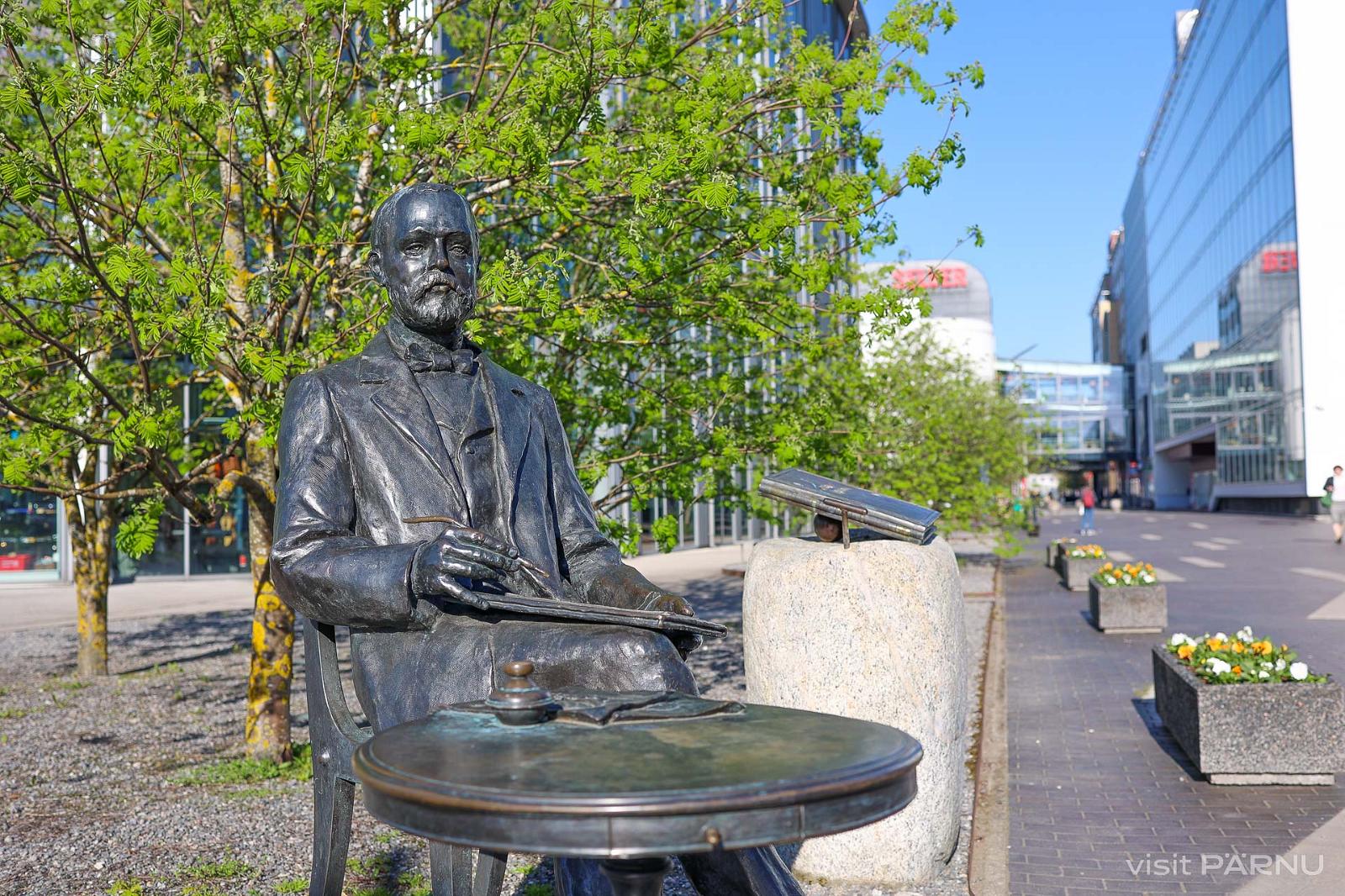
Gustav Fabergé taking a break in Pärnu. Source
Gustav got married and his first child, Peter Carl, was born in 1846. It seems the jewellery shop prospered and ran ahead under the sharp eyes of its managers. So Gustav, the epitome of a gentleman, decided to retire to Dresden, the Venice of the Elbe, and packed up his family for the big move. Peter Carl became a student at the Dresden Arts and Crafts School. Among Peter Carl’s favourite activities was to visit The Green Vault, a series of 10 rooms in Dresden Castle, displaying the brainchild of August the Strong: 3000 Baroque, Middle Ages, and Renaissance works made by the master goldsmiths and craftsmen of their times. To this day, the Green Vaults (the Historical and the New) display works of superior craftsmanship and creativity, and it is easy to imagine how they affected Peter Carl and influenced his life’s work.
Peter Carl, a good egg all round, was the consummate learner and underwent apprenticeship with the best goldsmiths in France, Germany, and England. He returned to St. Petersburg and, while working for the family company, he spent part of his time at the Hermitage Museum restoring gold masterpieces in the collection. This way, he learned old and perhaps forgotten goldsmithing techniques and ideas, and added them to what he already knew. Peter Carl finally took command of the House of Fabergé in 1882. He became a member of the rarefied club of best jewellers in the world when he was appointed goldsmith to the Imperial Crown of Russia.

Fabergé objects auctioned by Sotheby’s in 2008. Source
The crowned and moneyed world turned ravenous for Fabergé products. The company grew as it amassed international accolades, and by 1900 Fabergé employed 500 goldsmiths. New branches opened in Moscow, London, Odessa and Kiev. It is estimated that Fabergé has produced over 200,000 objets d’art. Besides exclusive jewellery, Fabergé produced just about everything for people whose hands touched only luxury, and whose eyes got easily bored on the best that money could buy: napkin rings, photo frames, parasol and cane handles, scent bottles, boxes, thermometers, cigarette cases, ashtrays, match holders, cups, decanters, bowls, vases, cutlery, tea services, desk clocks, icons, writing sets, buckles, fauna and flora miniatures, enfin, you name it and Fabergé made it.
If Fabergé did not make what you wanted, you could place a special order, as did Tsar Alexandre III who ordered an Easter egg as a present for his wife, Empress Maria Feodorovna, and allowed Fabergé a free creative hand. The result was the Hen Egg. It was such a success that the emperor ordered a yearly Easter egg for his wife, and moneyed people in Russia and abroad followed suit. The exact number of Fabergé eggs made is uncertain, but estimates reach 50 imperial eggs, of which 46 have been located. At least two of them belong to the British royal family and were shown in an exhibition. But the Museum Fabergé in Saint Petersburg is the one with the largest number of eggs and other objects d’art.
Fabergé had diversified so much that the company was able to help during the First World War. They made copper mugs and plates, syringes, and even grenades.

But power and fame do not last forever, and 1917 brought in the Russian Revolution and the end of the Russian imperial family. The company was nationalised, and its stock confiscated. Peter Carl Fabergé and his family decamped in different perilous directions, and some of them were imprisoned. Peter Carl fell ill and died in Switzerland, in 1920. His son, Eugène, moved to Paris, and re-established Fabergé & Cie – where best but the country the Favri family had left centuries ago?
All went well, until Eugène discovered in 1937 that Russian-American Samuel Rubin and Lenin’s pal Armand Hammer were using the name Fabergé in Russia and elsewhere without the family’s consent. Rubin produced perfumes under the name Fabergé, Inc. So French Fabergé & Cie. and Russian-American Fabergé, Inc., both unrelated, settled in 1951 when Rubin paid the original Fabergé the bagatelle of US$25,000.00 (approximately US$ 290,000.00 today) for the right of using the name in perfumes. Apparently, the original Fabergés knew a lot about gemstones and gold, but very little about perfumes. Against common wisdom, they had put all their eggs in one basket.
Meanwhile, Armand Hammer had gathered as many Fabergé items as he could in Russia and spirited them to America, where he found nobody wanted to buy them. Armand often sold the exquisite objects for scrap metal. And it was a scrap metal dealer’s luck that the eggy-thingy he bought for all of US$500 turned out to be the lost third imperial Easter egg which Tsar Alexander III had ordered for his wife. It was valued at US$33 million, but the auction house did not reveal the owner or the amount it reached at auction.

Fabergé’s Third Egg, sold as scrap metal after it was scuppered from Russia. Source
While Eugène and his original Fabergé company grew slowly in France, the copycat American firm followed a trajectory typical of any company with a brilliant future. It was sold to the cosmetics company Rayette, and formed Rayette-Fabergé; later its name reverted to Fabergé, Inc.; in 1984 Fabergé, Inc., was sold again and, three years later, it bought Elizabeth Arden for 700 million.

Fabergé Brut. Source
But that’s not all: the behemoth, multinational Unilever bought Fabergé, Inc. for a healthy US$1.55 billion in 1989. The company was responsible for the launching of some of the bestselling perfumes in America and worldwide, among them Tigress, Babe, and Brut. In 2001, the UK company became Lever Fabergé. This means the imposing, exclusive Fabergé name, so far linked to the best craftsmanship and luxury in the world, had now been downgraded to a series of mass-produced and marketed, horrifyingly common cleaning and personal hygiene products no multimillionaire would ever touch: deodorants (Rexona), soaps (Dove), detergents (Persil), lavatory disinfectants (Domestos). Well, it’s another way to sparkle.
To compound the insult, Unilever had obtained a trademark to produce several other items under the name Fabergé in America. Since then, there has been an astronomical increase in what has been termed Fauxberge objects, but especially “Faberge egg” trinket boxes made of expensive or cheap materials, but never reaching the craftsmanship and beauty of the original ones. Museums have not escaped the of curse of Fauxberge: the Faberge Museum in Baden-Baden and the Hermitage Museum in Moscow have both been accused of displaying fake Fabergé eggs and other objects.

Trickle down: Fauxberge examples in paper Source
In 2007, Fabergé Limited announced that it had “acquired the Fabergé trademarks, licenses and associated rights relating to the Fabergé name from Unilever. The Fabergé name is reunited with the Fabergé family.” Finally. But Fabergé is not in the family’s hand anymore. It belongs to another conglomerate, Gemfields, and its website is sprinkled with feel-good words such as “sustainability across the industry,” “contributes positively,” “sustainable livelihoods for the communities,” and it is involved in huge public relations do’s. Eugène Fabergé’s two granddaughters are involved in today’s company, and Fabergé has been slowly conquering the world: London, Kiev, Dubai, New York, Geneva, Venice… again.
With this plan of world domination in mind, I checked Fabergé’s sales website and I was not surprised that one of the cheapest items sold is a modest, petite egg pendant of 14mm with chain for €2,880.00. The beautifully designed and executed line “Summer in Provence” hasn’t even got a price online, so I have to ask them… but you know what they say, if you have to ask the price, you cannot afford it. I found many other elegant and gorgeous versions of eggs and egg-lockets to hang from my earlobes or neck. But I kept thinking, as exclusive as they are, why walk about with egg on my face?
Post amended on 20 November 2023 to reflect the correct year of the Russian Revolution, 1917.

 Regina's Rants
