

You may remember D. Pedro I, the fickle-hearted emperor. Now we have D. Pedro II, who was Pedro I’s only surviving male son born in wedlock, who became the second emperor of Brazil. They say that the apple doesn’t fall far from the tree, but how did Pedro II fare?
Pedro II, whose mother died in childbirth when he was 1, was born in Rio de Janeiro, and was abandoned age 6 by his father and stepmother. (They moved to Porto to help the liberals and restore the throne to Maria, Pedro I’s daughter and queen of Portugal. Maria’s throne had been usurped by her uncle and husband, Miguel.) While his parents were so entertained on the other side of the Atlantic, Pedro II (henceforth called Pedro), a minor, waited for his majority in Rio under the regency appointed by his father: José Bonifácio de Andrada, a politician who helped engineer Brazilian independence; Maria Carlota de Verna Magalhães Coutinho, the nanny; and Rafael, a black veteran from the Cisplatin War, charged with protecting Pedro.
It didn’t take long for José Bonifácio to be substituted by another politician, and for the regents to establish a Spartan regimen for Pedro’s life: he woke up at 06h30 in the morning, and went to bed at 10h at night. He was allowed two hours of playtime a day. The threesome taking care of Pedro made sure he behaved his best at all times, and listened and learned more than he talked. Everything they did was supposed to transmute Pedro into a truly majestic emperor. In reality, most of the efforts were directed at stamping out what they imagined to be the young boy’s genetic pitfalls: the father had lost not only his reputation, but also besmirched the history of the burgeoning nation he had helped create. So, Pedro’s supposed impulsivity and irresponsibility had to be uprooted before they had time to show.
Pedro had few friends his age, and his two sisters had little contact with him. His father and stepmother died, so he could no longer look forward to family time with them. Pedro was a lonely kid, but his tutors were in luck: Pedro liked to read, and was like a sponge absorbing new knowledge.
Pedro was also a political pawn, taken advantage of and thrown here and there by different friends and political factions, but that tomfoolery stopped, in part, when Parliament declared his majority at age 14, instead of 18. He unified the country by being a quiet and non-defiant emperor, listening to everybody, saying just one right word here and there. Meanwhile, many politicians’ power had been pulverized, and in its place rose a clique of what Harry and Meghan would call palace insiders or something, but in reality, they called themselves the Aulic Faction.
When he was seventeen years old, Pedro had already grown to 1,80m, tall for that time, but he was a moody teen who made sure his books were always nearby. The Aulic Faction believed Pedro would be best served in private and public life if he were kept busy by a wife. They found a willing candidate in Princess Teresa Cristina, from the Kingdom of the Two Sicilies. Her portrait was sent and her beauty approved from the catalogue of beauties, and their marriage by proxy happened in 1843.
Three Brazilian ships accompanied Teresa Cristina to Rio, where Brazil’s new empress would meet her emperor for the first time. As etiquette dictated, Pedro welcomed her at her ship. When Pedro saw Teresa Cristina, he immediately turned his back on her, felt faint, and someone brought him a chair to sit down. (This part of Pedro’s reaction was similar to his father’s when he saw his second wife for the first time: he felt faint, and madly in love with her.) Pedro then said what was possibly one of the longest sentences he ever uttered, “They deceived me.” Teresa Cristina was, according to different descriptions, nothing like the portrait that had sold her; she was ugly, fat, and walked with a limp. Still, noblesse oblige: Pedro couldn’t return her as if she were a hoi-polloi mail-order bride (although, come to think of it…).
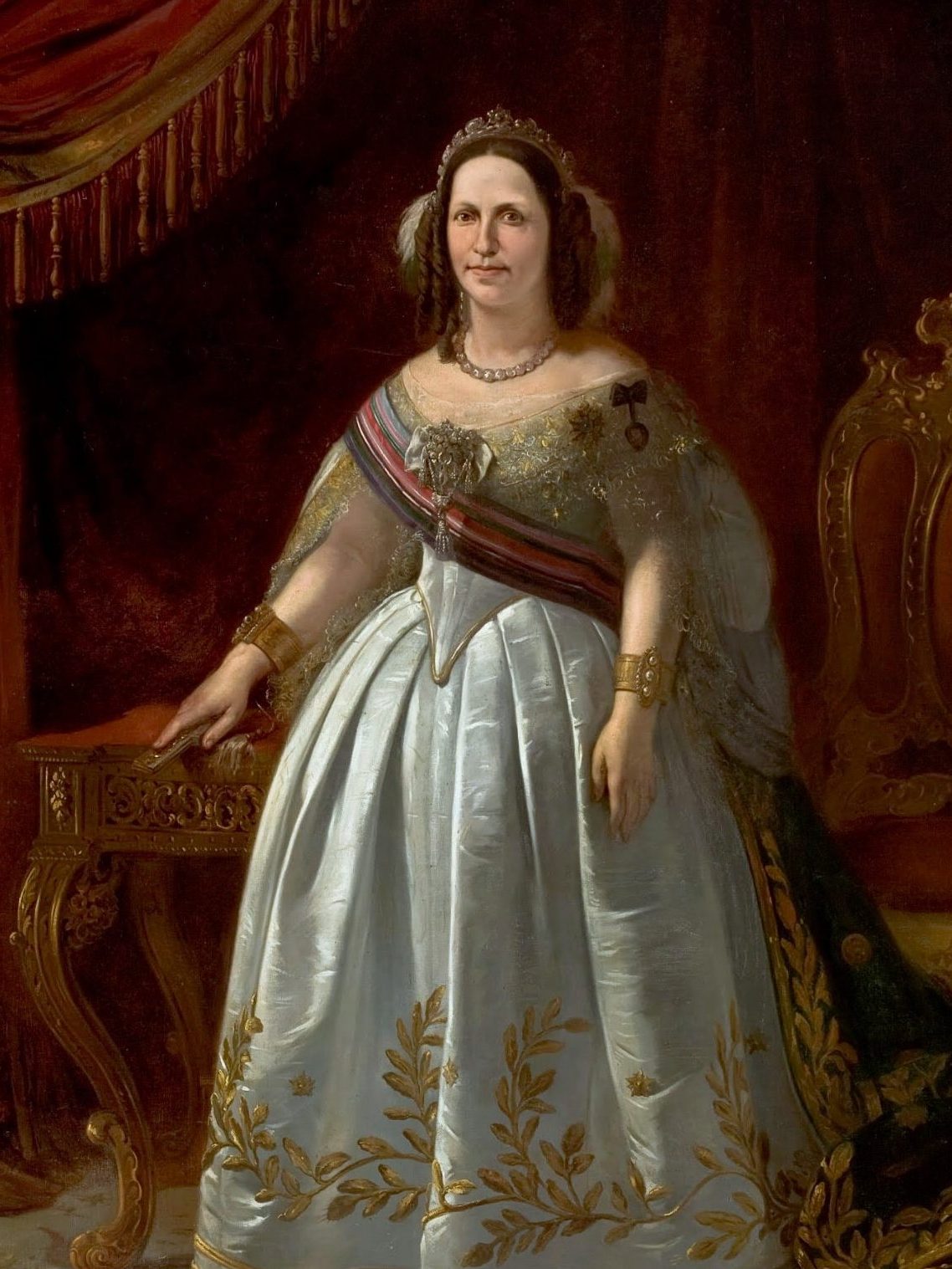
It was a difficult marriage, and Pedro, the teen, was typically sullen. That lonely boy who wanted above all his books and a beautiful wife to love and perform his duties upon until the end of his days, was just not into his marital duties. Months — a year — passed without a pregnancy announcement. Rumours spread like wildfire that the emperor was indeed having serious trouble in the crown jewels department. Pedro’s father, famous for having had an infinite number of affairs, must have been turning in his cold grave in Portugal.
Eventually, Teresa Cristina, desperate for the lack of consummation of marital obligations, threw in her Egyptian cotton towel and said to Pedro, “I humbly beseech Your Royal and Imperial Majesty an agreement for my return to the Kingdom of the Two Sicilies.” (Or something like that.)
“Huh?” said Pedro.
“Didn’t you hear me?”
“Yeah. Nah.” (Or perhaps it was, “Nah. Yeah.”)
There is no record of what went on after that intense dialogue, but it is easy to imagine. Pedro and Teresa Cristina had two boys and two girls in four consecutive years. The two boys died young, so the Brazilian empire’s crown rested on the hope of two surviving princesses, Isabel, the oldest, and Leopoldina, the extra.
By all accounts, the imperial marriage hobbled along with a tiff here or there, but peaceful most of the time: Teresa Cristina yielded to Pedro’s vast knowledge of things and he was the boss. Even when imperial duties were considered, theirs was felicitous marriage. Above all, Pedro and Teresa Cristina agreed that the empire demanded a man at the helm, and Isabel was not right for the job because she was a woman. Even though the Constitution allowed a woman to be head of state, they excluded Isabel from any form of government training and she married the Count d’Eu, a French nobleman.
It is said that Pedro had interests on the side, too, but he was not as famously adventurous as his father. Discretion was Pedro’s byword. Naturally, he was not as discreet as he thought he was, how could he when a horde of courtiers followed him all day? As it often happens, Pedro’s attention was drawn to an aristocrat deemed deserving of more attention than others, and she became famous because she lasted longer than all the others.
If Pedro was a little quiet and erudite, Luísa Margarida de Barros Portugal was fiery and knowledgeable. Luísa was the daughter of the Viscount of Pedra Branca, owner of a huge library which she used liberally. She was married to the Marquis of Barral, who stayed in Paris while she discharged her duties in Rio. Luísa became the governess for the imperial princesses, Isabel and Leopoldina. (It wouldn’t be the first, or the last time a pater familias had an affair with the au pair.) On top of that, Luísa was also nominated to be a lady-in-waiting for Teresa Cristina. Tsk. Tsk.
To be fair to all involved, it is also said that there is no proof that Pedro and Luísa had become an item. (What proof did these people want? To be caught red handed?) The argument and proof that they did not have an affair rests on shaky foundations: Luísa was a very, very Catholic person, therefore it did not happen. That’s when we all ask, “Since when has being a Catholic ever stopped anyone?”
While all that was going on, Pedro discharged his affairs of state with determination: he went to sleep at 2 am, and woke up at 7 am. He demanded politicians and civil servants to work eight hours a day. He was frugal, forbade balls and showy events, but it took him 49 years to decrease his payments from 3% of the country’s expenses to 0.5% in 1889. Considering the country’s revenues had increased 14-fold during that time, there was probably no decrease at all in the amount he was receiving.
Pedro was a 19th century renaissance man. He had learned and appreciated new ideas, enjoyed discussing them with their inventors abroad, personally and by correspondence. He wrote and spoke thirteen languages, including Tupi, the lingua franca of Brazil’s indigenous people. He was the first person to bring and use a daguerreotype in the country, and establish a photography laboratory. He founded several societies that fostered education, the arts and sciences. He respected the Brazilian Parliament and was impartial. His libraries had accrued 60 thousand books, and while he admired Darwin for his Theory of Evolution, all his erudition was not enough to convince him to end slavery.
The emperor had already ratified the Parliament’s Lei do Ventre Livre, or the Law of Free Birth, in which children born of a slave woman would be free, but was unwilling to do more. It fell to Imperial Princess Isabel, acting regent while her father enjoyed one of his long travels to Europe, to sign the Lei Áurea, which abolished slavery in 1888.
The results weren’t fun. The rich farmers didn’t like the abolition of slavery, and part of the population hated that the country was headed by a woman married to a foreigner. Pedro returned to Brazil, and joined the government to save the monarchy: they offered low-interest loans, distributed titles of nobility. In 1889, he heard of a military coup to end the Brazilian empire, sighed, and said, “If that’s what it is, it will be my retirement. I worked too much and am tired. Now I’m going to rest.”
The imperial family was exiled to Europe, their palaces confiscated. They stopped first in Portugal, where Teresa Cristina died in Porto. Pedro, whose moniker was the Magnanimous, lived for the rest of his life with handouts from friends in cheap hotels in Paris. He died in 1891, and the French government pulled all the stops for his state funeral, attended by over 300,000 people. His remains were first buried in the Bragança Pantheon in Lisbon, and later sent to Brazil. His remains rest in the Imperial Mausoleum in the Cathedral of Petrópolis, the city he built.

 Regina's Rants


You must be logged in to post a comment.