
Shame on me. I had never heard of writer Jan Morris until recently, when I watched a rerun of the 2016 BBC programme titled “An Extraordinary Life: Michael Palin and Jan Morris”, celebrating her 90th birthday. Born James, Morris had been an intelligence officer when he first arrived in Venice in 1945. Later, he was the Times’ journalist who joined the 1953 Everest Expedition and reported on Hillary and Tenzing’s reaching the summit of Mount Everest. Morris was the first person in England to undergo a gender reassignment surgery in Morocco in the 70’s, because mores dictated that in the UK you could not be a woman and remain married to your wife, something that created all sorts of problems for her, her wife Elizabeth, and their five children. They had decided to stay married, but had to face the law: same-gender marriages were forbidden then. They got a divorce. After a lifetime together, Jan and her life companion, Elizabeth, entered a civil partnership in 2008.
Facing Morris’ 40 books or more, it was difficult for me to decide where to start my Morris education. I decided on her last book, a slim non-fiction volume, Allegorizings. Morris had sent the manuscript to her publisher with instructions to be published posthumously. I did not finish Allegorizings because I forgot it in carriage 11 of the Lisbon-Faro train. I reordered it and while I waited for the delivery, I took up Venice, which was next in the endless pile of books-to-read on my desk. Venice was written by James and first published in 1960, but revised by Jan in three subsequent editions; mine was the last, from 1993, which has been reprinted several times.
Morris’ first trip to Venice was followed by countless visits to the city, and a one-year sojourn when she wrote parts of Venice. Her way of getting to know a city, which probably differs from yours and mine is, “The first place I visit is the law court … Then the market. And the railway station.” Hence lies the approach of this book, which does not disgorge historical dates and names of important generals or doges in their natural orders. Neither is it a travel book that directs the reader to unmissable attractions and must dos. Paradoxically, it is an important source of knowledge about Venice from its inception, and it is possible to read it and enjoy it while never having set foot in Venice (and never intending to do so), as well as a groundwork for a trip to La Serenissima – it does not even require to be read in the chapters’ order. Morris is an analyst, a psychologist, “a writer reaching maturity” as she said, guided by unbeatable wit, surprizing clarity, and kind eyes.
Morris skips recommendations from Caffè Florian’s 61-page menu, or the best romantic gondola ride soaked in prosecco while a tenor tries to keep his balance and blasts his lungs out in the Grand Canal (I have seen this a few times, and do not recommend it.) However, there’s much more to entertain the reader in the book’s three main parts: the people, the city, and the lagoon.
I have been to many Venetian restaurants, some better than others, and can empathise with Morris’ idea that Venice “is not, for example, a gourmet’s city. Once upon a time the cucina Veneziana was considered the finest in the world, specializing in wild boar, peacock, venison, elaborate salads and architectural pastries. …Aretino, the poet-wastrel, used to say that the Venetians ‘did not know how to eat or drink’, and another commentator reported caustically that the pride of Venetian cookery was the hard biscuit, which was particularly resistant to the nibblings of weevils (some left in Crete in 1669 were still edible in 1821).” Neither have I had, in Venice, “a dish called mista mare, a fried pot-pourri of sea-foods, that can be delicious, at least for the first twenty or thirty times.”
I think of Venice now and the gargantuan cruise ships that disgorge tourists who huddle in hapless groups following a tour guide who has memorised all the minute details of dates and doge’s names, brutal invasions, architectural details, best poisons, Venetian wine pairings. They shepherd their numerous, transient flocks with a closed umbrella decorated with ribbons, held aloft. The options are to follow the right brolly or get lost in another group, but the tourists are on a mission to get Venice done in one morning or afternoon, the time allotted to them by the cruise programme, and they leave feeling that they got their money’s worth, and above all, they know Venice.
Mass tourism, according to Morris, is nothing new to Venice, and “the Venetians have always exploited the holiday assets of their city. Even in the fourteenth century it was a city of hotels.” Besides, “as early as the thirteenth century the Venetians had their Tourist Police, to inspect hotels for cleanliness and comfort, and speed the lost visitor (in any of several languages) towards the more expensive shops.” While a medieval Venetian monk wrote, “the piazza of St. Mark’s seems perpetually filled with Turks, Libyans, Parthians and other monsters of the sea,” these days “Americans are the most numerous visitors, followed by Germans, the French, Britons, Austrians, (…)”
When asked about what she thought about Venice’s current plights with tourists, Morris wrote in an update article that “…each time I went back there the more artificial the city seemed. (…) Many Venetians had abandoned their homes for the mainland, where life was cheaper; many richer city folk, Romans and Milanese, had replaced them. The numerous feral cats of the city, old friends of mine, had been cleared away for health reasons. (…) It is still the place, as it always was, for preposterously vulgar galas, weddings, and parties, and for myself I even welcome those hideous white cruise ships, looming over the glorious quayside, to the distaste of all purists. They seem to me truly emblematic of Venice, the plutocratic sea city – brilliantly engineered, marvellously showy, and vastly profitable, just as the doges would have liked them to be in the glory days of old.”
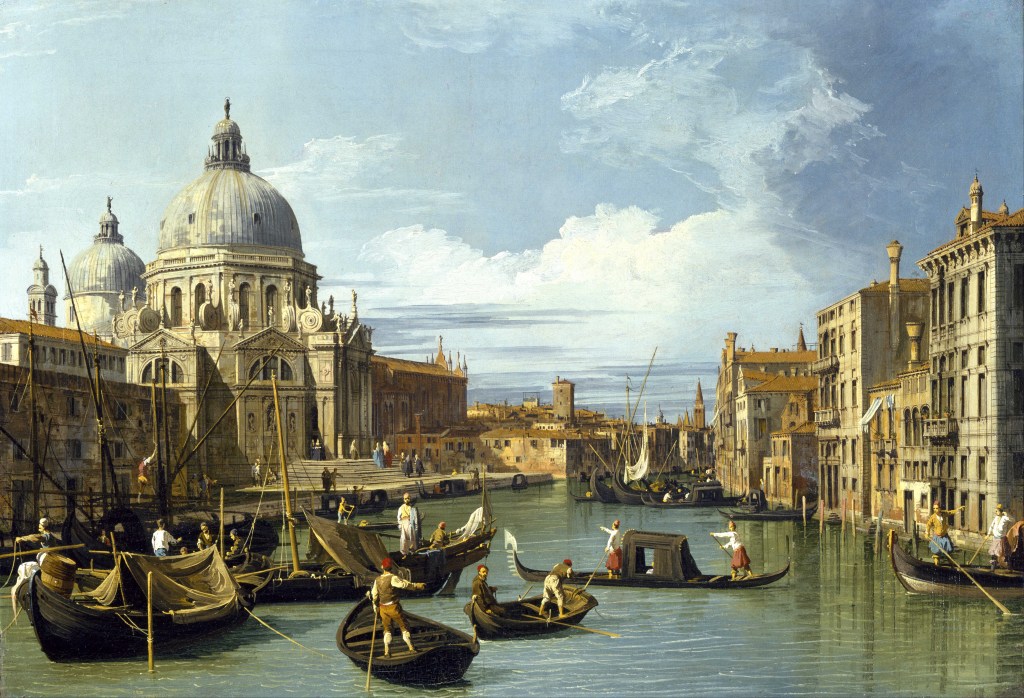
I first went to Venice in the 80’s, and have been overwhelmed at times by its beauty, despite the age and decay (the city, not mine). I had trouble finding the words to describe the feeling, until the moment I read, “And sometimes, in the Venetian spring, you awake to a Canaletto day, when the whole city is alive with sparkle and sunshine, and the sky is an ineffable baby-blue. An air of flags and freedom pervades Venice on such a morning, and all feels light, spacious, carefree, crystalline, as though the decorators of the city had mixed their paints in champagne, and the masons laced their mortar with lavender.” This.
This is Morris’ Venice, and nobody else’s. It makes me yearn for a return to Venice to discover at least a sliver of the richness and inspiration that Morris found. I’m grateful Morris shared her Venice with us.
And how about my Allegorizings? I received my second copy, and was half-way reading it, when I took it with me to a visit to the doctor’s and forgot it somewhere. Destined not to finish it? Shall I order a third copy?
Morris, Jan (1993). Venice. London: Faber and Faber. 307 pp.

 Regina's Rants

You must be logged in to post a comment.