

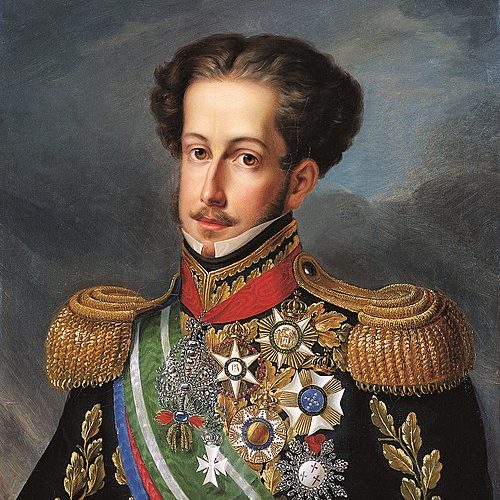
When Dom Pedro I, the first emperor of Brazil and later King Pedro IV of Portugal, died in 1834 at Queluz, Portugal, he left a will ordering the transportation of his body to Brazil, and his heart to Porto. Could such an exalted man have made his feelings clearer? He loved Portugal beyond life itself and that love would never fade in death; for centuries to come his descendants’ and their vassals’ chests would swell up with pride and they would know that Portugal was his real, most beloved land. Brazil, where Dom Pedro I spent 23 of his 36 years, could keep his less eminent remains – yet why did it take 138 years before his remains were taken to Brazil? And why did Brazilians demand his heart back 188 years later? Let’s go back a few centuries.
Dom Pedro arrived in Rio de Janeiro in 1807 aged nine, after his father, Prince Regent Dom João, and his mother, Dona Carlota Joaquina, fled Lisbon in a strategic retreat from Napoleon Bonaparte’s fiery army. Pedro’s father had become the Prince Regent because his mother, Queen Maria, had been the object of a declaration signed by no fewer than seventeen doctors stating that she was incapable to reign due to her mental state. She was talked about as The Madwoman.
By running away from war at home, braving wild Atlantic waves, winter tempests in the north, and doldrums in the south of the Equator, the Portuguese royals proved to be ahead of their times: they were the first asylum seekers to arrive in Brazil by sea, albeit not in rubber dinghies, but proper stately ships overloaded with 10,000 or more hangers-on distributed among major and minor royalty, high-ranking public servants, the help, assorted belongings and dwindling supplies. The fleet of 62 varied ships included 13 English warships to guarantee the royal family’s protection (another name for coercion: Off to Brazil you go! Off!).
The rush to Brazil was so last minute that although the royal treasury and some artworks were loaded in the ships, much of their belongings stayed at port: furniture, sacred silver items from churches, and 60,000 tomes of wisdom (or not) from the Royal Library. Typically, the furniture disappeared, the silver was melted by the Napoleonic army to subsidise the war, and the books, which nobody seemed to want, were eventually shipped to Rio de Janeiro.
While still in Portugal, Young Pedro grew up in the trembling shadows of his parents’ battles for power and relevance. His father reigned over the country and Brazil, and his mother, a Spanish Bourbon no less, did her best to do the bidding of her country and undermine her husband. After guaranteeing the future of the Portuguese house of Bragança with a total of nine children, Carlota Joaquina went on to plot against her husband to become a proper, powerful reigning queen. But João discovered Carlota Joaquina’s schemes and her long string of lovers. Instead of chopping off her head or sending her to jail, as was the custom then, he avoided a royal scandal and banished her to spend her plotting days at the not so queenly Ramalhão Palace, while he reigned from the splendid Palace of Mafra. Pedro and his siblings lived in the no less splendid Palace of Queluz, and met their parents only during official ceremonies.
Carlota Joaquina spent her afternoons in Rio smoking marijuana and drinking
a mix of fruit and alcohol, a precursor of today’s caipirinha.
It is said that João and Carlota Joaquina never slept under the same roof again. When the royal family fled to Brazil, João travelled in a ship with his sons, and Carlota Joaquina in another with her daughters and Queen Maria, each with their groupies and servants. In Brazil, João eventually chose to live in the mansion of a local merchant at Quinta da Boa Vista (after many modifications, because the mansion was not palatial enough) with his sons. Carlota Joaquina chose a farm near the beach in Botafogo, where she used to swim naked, and where she kept an eye on her daughters and Miguel, her youngest son. (Apparently he was the result of a liaison with a squire, or a doctor, or a marquis, or a gardener, or a stable hand, who knows?) She maintained her coterie and continued to plot against her husband while she tried to establish her own monarchy of Spanish America. In the process, she took countless lovers, and demanded that the local population, whom she hated, knelt as she passed in the streets. Still, women back then seemed to admire and envy Carlota Joaquina’s huge collection of shoes, most of them red. I don’t know if people in general would approve her long afternoons spent smoking marijuana and drinking a mix of fruit and alcohol, a precursor to today’s caipirinha. Not-So-Young Pedro, by then, had gotten into the habit of calling his mother The Whore.
The royal family’s arrival in Brazil had been a double-edged sword, despite the fact that Brazil, the colony, became then the seat of Portuguese government for the United Kingdom of Portugal, Brazil and the Algarves. While Brazil got an upgrade from colony to kingdom, Portugal became a distant, weakened suburb. Real Portuguese people living in Brazil hated the fact that the colony’s inhabitants had acquired the same rights as them. The pull of nationality would be the entwining and separating factor in the history of Brazil and Portugal.
Dom João felt the intense pressure from desperate members of the royal family and courtiers in need of stuff that either did not exist in the new land, or had been consumed by the unplanned surge of aristocrats and their toadies. Until then, colonial Brazil had been allowed to trade only with Portugal, which led to an unpredictable availability of goods. So Dom João declared open all Brazilian ports for trade with all friendly nations.
The royal family and their courtiers expected to be supported in every way by the locals. Families that had long-established themselves in Rio de Janeiro woke up one day to find the initials PR painted on their doors. That meant the Príncipe Regente had requisitioned the house for courtiers’ use, but the local population interpreted it as Ponha-se na Rua (Get out on the street). Local inhabitants had no choice but to leave with only the clothes on their backs. If they refused, the army would vacate the property by no gentle means.
With the death of João’s mother, Queen Maria I, in 1816, he was promoted to King João VI. But it took him until 1821 to decide on a return to Portugal. By then, Carlota Joaquina’s demands to abandon Brazil were piercing his ears, for her plans for a South American Spanish kingdom had crumbled; Portuguese troops in Rio de Janeiro had revolted because they wanted the king to sign a new Constitution in Portugal (among other matters, returning Brazil to the state of mere colony without political autonomy); and João was determined to quash a liberal revolution fermenting in Porto and threatening to spread to Lisbon.
Already a cognoscenti of retreats, João swiped Brazil’s bank of its contents of gold, silver, gems and the last coin, retrieved the remains of all the royals who had perished in the colony, and picked the 4,000 people to accompany him in the twelve ships bound for Lisbon. His ship was named Dom João VI (Duh!). He was going to start his new kingly life, supported by his Brazil-hating, conspiring wife, and the pliable Portuguese court. In exchange for all the dosh and royal rattling bones he took from Brazil, Dom João VI there left his son and heir, newly titled Prince Regent Pedro and his family, to take care of affairs. It seemed a fair deal.
Adult Pedro had by then made a florid name for himself in the high and low echelons of society, due to his illicit liaisons with married and unmarried women, his out-of-wedlock children, and his uncontrolled sexual harassment in and out of court. Despite all the red flags, in 1817 he had managed to marry Maria Leopoldina, daughter of the all-powerful Emperor Francis I of Austria. For her, it was love at first sight when she disembarked in Rio de Janeiro and saw Pedro (who had by then acquired the local habit of bathing often). They had seven children, even though it is reported that Leopoldina hated sex, despite Pedro’s fragrant body. Perhaps Leopoldina felt humiliated. Besides Pedro’s marauding behaviour, he had also given the title of Marchioness of Santos to Domitila de Castro, his favourite lover, no doubt for services rendered. Then Pedro installed Domitila as Leopoldina’s lady-in-waiting. (Urgh!)
While João was an absolutist who had gone to Porto to fight the liberal cause,
his son had become a liberal who fought for his ideals in Brazil.
Pedro spent the year after this father left in his usual sexual exertions, but he also found time to spew out decrees that guaranteed personal and property rights in Brazil. While João was an absolutist who had gone to Porto to fight the liberal cause, his son had become a liberal who fought for his ideals in Brazil. Pedro also battled a mutiny among the Portuguese troops who wanted to take over the government, wanted him to swear allegiance to the absolutist Portuguese Constitution, and return to Portugal. This exasperated Pedro, so he declared the independence of Brazil from Portugal on 7 September 1822, immediately promoted himself to Emperor Pedro I, and proceeded to crush all who still carried a torch for Portugal. Pedro’s army swelled with Brazilians, and they fought all over the country defending freedom. His wins were legendary, but he did not count on the fact that the republican Revolução Pernambucana had grown in strength and formed the Confederation of the Equator, a group of three insurgent provinces (Pernambuco, Ceará, and Paraíba) in the northeast of the country. Somewhat irrationally, the Confederation had renewed its support to King João VI, and demanded independence from Brazil itself, because the new Brazilian constitution was emperor-centric, therefore not liberal at all. Few thought the Confederation´s objectives were a return to Brazil being a colony.
By 1824, Pedro must have been tired of fighting in far-away lands, and wanted to head home to his long-suffering wife and lovers. Or he was skint. So he decided to borrow heaps of money from England, contracted mercenaries (the Wagner troops of Pedro’s day), and declared Thomas Cochrane head of the attack on the Confederation of the Equator. According to reports, it was the bloodiest episode of the empire era in Brazil. Cochrane won. The heads of the Confederation were all identified, condemned to death by hanging, and executed, which was enough to put the kibosh on the revolt. Surprisingly, in 1825, Pedro issued a general pardon to surviving confederates. Was his heart going soft?
Sadly, Empress Leopoldina, beloved by the country, died that same year. Many believed Leopoldina had been poisoned by Domitila, whose house was then surrounded by the population and pelted with stones. (Yes, everybody knew.)
For some reason nobody could fathom, Pedro felt guilty about the way he had treated Leopoldina. He sent Domitila away from court, was seen embracing a portrait of Leopoldina and crying. He claimed he had seen Leopoldina’s ghost in the palace. Pedro repented, forsook carnal pleasures, and started searching for another royal wife in Europe. But rumours had reached Emperor Francis I of Austria (his former father-in-law) that Pedro had pushed Leopoldina down a flight of stairs, which provoked her death. Pedro’s reputation was so tarnished that Francis forbade any princess of the Austro-Hungarian empire to marry him, and by then all European royal houses were protecting their fillies, too. What’s an emperor to do? Pedro wrote mea culpa letters to Francis, emperor-to-emperor confessions, swearing for all that was most sacred that he was now a different person, reborn, he had changed, etc., etc., etc. I mean, who would not believe Pedro? But his pleas fell on deaf ears.
However, it is a known fact that an emperor needs a woman’s company. In April 1829, Domitila was back in the royal fold. By August, Pedro received news of his engagement contract to Princess Amelia de Leuchtenberg, unable to find a suitor herself because she was related to Napoleon, that troublemaker who had caused untold distress in Europe and, most importantly, now held no power. Pedro wasted no time: the semen was still wet on Domitila’s chin when she was dispatched back to her native São Paulo, this time for good. When Pedro saw Amelia for the first time, her beauty so affected him, his heart was so overcome with love, that he felt faint. And he never as much as nudged another woman for the rest of his life. (Or so they say.)
It is said that Pedro I left a total of thirty-four children,
adding official and non-official ones.
Meanwhile, things were getting complicated in Portugal. Pedro’s father, Dom João VI, died by arsenic poisoning in 1826, and, surprisingly, nobody thought Carlota Joaquina had done or mandated the deed. Emperor Pedro I of Brazil then accumulated the crown of King Pedro IV of Portugal, and found himself in the uncomfortable position of reigning two countries with conflicting interests. He could not deal with the heat and, after two months as king of Portugal, Pedro abdicated. His sister Isabel Maria became regent to his eldest daughter, who became Queen Maria II of Portugal. Isabel Maria became ill (so far, no poison suspected), and the new regent was Maria’s uncle, Miguel (Pedro’s brother or half-brother; supported by Pedro’s mother Carlota Joaquina, still plotting for absolutism). Being a regent was not good enough for Miguel, so he became Maria’s fiancé and, upon marriage, deposed his wife and declared himself King Miguel I. That’s family for you.
Meanwhile, Pedro lived his idyllic life with his beloved wife in Brazil, until 1832, when it could be said that Brazil declared war on Portugal. Pedro gathered another mercenary army and invaded Portugal, meddling in a civil war between liberals from Porto (who hated the royals but supported Pedro) and absolutists in Lisbon. With the liberal win, Maria II became queen for the second time, had her marriage to Miguel invalidated by the Vatican, and banished her ex from Portugal. While Pedro, the valiant emperor, died of tuberculosis in 1834.
It is said that Pedro left a total of thirty-four children, adding official and non-official ones. He recognized only four children out of wedlock: two by Domitila de Castro, one by Domitila’s sister, and another by the wife of a wealthy shopkeeper.
And how about Pedro’s remains and heart? As mentioned, his will and command was for his heart to stay in Porto, and his other remains to be sent to Brazil. Indeed, his heart was sent to Porto, but his body was interred in the Royal House of Bragança Pantheon at the Monastery of São Vicente de Fora, in Lisbon (1). Pedro, in death, had never returned to Brazil. Not only that, but Pedro was buried without any of his Brazilian ensigns, and only the Portuguese ones considered. How could they disregard his last wish? Ah, worry not.
Fast forward to 1972, in the middle of a brutal dictatorship, when Brazil approached her 150th independence anniversary with fanfare and public jubilation involving festivities at all levels of society. There was even a mini football world cup with twenty international teams, where the final adversaries were (Surprise!) Brazil and Portugal, and the result was (Surprise!) Brazil 1-0. The organising powers of the military junta were amazing.
Dead for 138 years, Emperor Pedro I arrived for the second time in
Rio de Janeiro to great acclaim and joyful commemorations.
To top all celebrations, someone in Brazil’s military junta had the unequivocal and unsurpassable idea to correct a historical slip-up and bring Pedro’s remains to Brazil. Diplomatic missives and dictatorship-to-dictatorship courtesies between the two countries crossed the Atlantic and yielded impressive results. Pedro’s remains were disinterred from the Bragança Pantheon and, with all pomp and circumstance, shipped to Brazil under the stern gaze of Américo Tomás, figurehead President of Portugal, his wife, daughter, and tons of flunkies. Dead for 138 years, Emperor Pedro I arrived for the second time in Rio de Janeiro to great acclaim and joyful commemorations.
Done with the receiving lines in Rio de Janeiro, the plan was to parade Pedro’s morbid remains in his glossy coffin to each state capital in the country. Twenty-one states accepted the imperial coffin’s visit with ceremonial spectacles, vigils and endless viewing queues. The exception was the state of Pernambuco, still stinging, who refused to honour the man who had spilled so much of her compatriots’ blood during the Confederation of the Equator.
After Pedro’s skeletal tour, he was put to rest in the Imperial Crypt and Chapel in the Monument of Independence of Brazil, in São Paulo, all situated at a location imagined to be near where Pedro declared the country’s independence. The remains of his two wives keep Pedro company in the crypt, for old habits die hard. It took a long time, but His Imperial Majesty, Constitutional Emperor and Perpetual Defender of Brazil, was finally home. Much to the delight of a military junta that managed to manipulate vast parts of the country into a jingoistic stupor.
There was the small matter of Pedro’s heart, though. It is said that Pedro’s instructions to inter his heart in Porto was like a macabre thank you note to the city that supported him when he invaded Portugal, a memento mori of his liberal ideals and ultimate sacrifices. Maybe his heart had gone soft after he met Amelia. But upon his death, his daughter Queen Maria II determined that his heart should be kept under lock and five keys at the Church Nossa Senhora da Lapa in Porto, where Pedro used to attend military mass.
The Emperor’s heart is entombed in a mausoleum in the main part of the church. To open the mausoleum, two keys are necessary to remove a five-tonne copper plate. Then an iron grille needs to be unlocked with another key, and then the containers: one a wooden case, and another a kingly mahogany box. Inside one finds the gilded silver reliquary with the house of Bragança arms finial, and finally, a pedestrian, hermetically sealed glass container with the heart itself immersed in lashings of formaldehyde.
And what type of person would think about claiming the heart back to Brazil? Again, fast forward fifty years from the sesquicentenary and in 2022 one finds the Independence Bicentenary, by which time Brazil and Portugal had done away with their dictatorships and breathed the fresh air of democracy. Sort of.
Just like in the 150th independence anniversary when Dom Pedro’s remains arrived in Brazil, someone near president Jair Bolsonaro, who had often defended the military dictatorship, had the brilliant idea of getting Emperor Pedro I’s heart back to Brazil for a peep. Diplomatic courtesies wafted from both sides of the Atlantic again, the left-over members of the Brazilian royal family, defunct but always hopeful to come back to power, were consulted. But before agreeing to anything, the Guardians of the Heart in Porto needed to scientifically establish if the heart was in good shape to withstand such transatlantic trip strapped to a comfortable seat in a Brazilian Air Force jet. Yes, said the scientists. (I suppose as long as the heart did not exert itself.)
Before sending the heart to Brazil, Porto Câmara decided to give it a send-off and displayed it for two days. It was also part of their celebrations of the 200th anniversary of Brazil’s independence. Perhaps the Porto display served to show Brazilians that they knew what the heart looked like, and they expected the same heart back. Heartnapping was, therefore, off the agenda.
In Brasília, the heart received an emperor’s welcome, worthy of the highest state visit the likes of which the population had rarely seen, with ambassadors and the defence minister wearing their best silk ties and polished shoes, and the military in their gleaming gala uniforms. And, of course, the health minister was there – what if the heart had a heart attack? Most importantly, Porto’s Chief of Police was present, to make sure the heart returned to its rightful place in Porto. He must have been worried when the heart was transported to the presidential palace in the presidential Rolls Royce.
Bolsonaro, a cheap copy-cat of Donald Trump, milked the heart and tried to squeeze as many votes as he could from it. He welcomed the heart in its gilded urn at the presidential palace, with a speech and anxious looks at his wife, who looked like she was going to puke or do a runner. Or both.
The heart stayed on display in a spacious, specially prepared exhibition room at Palácio do Itamaraty foreign affairs ministry building, where 10,000 school children (always use them to bloat the numbers) and adults filed through. Which is not much, considering Brazil has a population of 215 million.
The usual bodyguards accompanied the heart back to Porto, and it went on display again for two days. I suppose The Guardians of the Heart couldn’t just say the heart had arrived back intact, they had to prove it, and they needed witnesses. A total of over 5,000 people attended the pre- and post-independence day events. Portugal has a population of 10.5 million, so it could be said that the Portuguese were more interested in Pedro’s heart than Brazilians.
In the end, Bolsonaro’s inflated ceremonial reception of the relic fell flat like the votes he did not get, and unveiled much of the demagoguery grasping his government. It seems jingoism does not work so well in our times. And nobody in his government had noticed.
The Brazilian royal family was deposed with the proclamation of the Republic in 1889, and banned from the country. They lived in different parts of Europe until the ban was rescinded in 1920 when some members slithered back to Brazil. The current holder of the extinct title of Emperor of Brazil, Dom Bertrand de Orléans e Bragança e Witellsbach, wishes for the monarchy to rise from its ashes. Perhaps he imagined that the exhibition of his great-great-great-grandfather’s preserved heart would help his plans. In his plans, it seems, he tries to clench prospective vassals’ hearts for donations through a credit card machine kept in his sitting room. Money is not all an emperor needs, so Bertrand has developed exceptional imperatorial opinions, such as: global warming was invented by eco-terrorists and the Workers’ Party; couples must not get divorced, but if divorced, people should not remarry; indigenous people’s protection is a tactic invented by the communists; the Workers’ Party wants to turn Brazil into a Soviet republic; there is no racial problem in Brazil; public money should be given to private schools; Prince Harry should have married a noblewoman, and he is not a fan of Kate Middleton either. Never mind, he never got married: he needs all the time in the world for his cause. He probably does not know that an emperor’s first task is to have a heart.
I wonder what D. Pedro I would say about his heart´s jet-setting and free Rolls Royce ride, the fanfare, and the public relations schemes attached to the most important part of his body (or second most important). Perhaps he’d say that Brazil and her leaders needed to stop the faff and regain their ideals, composure, and honesty. Once and for all.
(1) Details about D. Pedro I’s internment in Lisbon and removal of his remains to Brazil were clarified to me by Ms. Joana S. Coelho, Coordenadora, Mosteiro de S.Vicente de Fora; and Mr. Miguel Gonçalves, Direção de Programação e Serviço ao Visitante dos Parques de Sintra. Muito obrigada a ambos.

 Regina's Rants

You must be logged in to post a comment.