
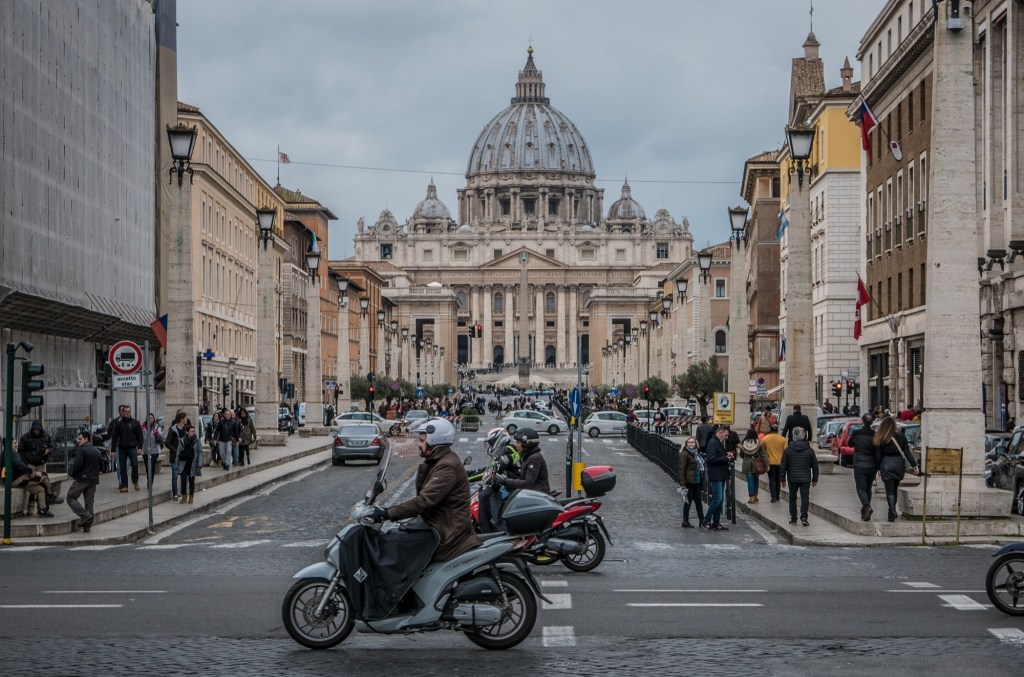
Hide the Phallus and Your Wallet
The Catholic world revolved around Portugal from 1 August, 2023, for five days. Pope Francis descended on Lisbon for the 37th World Youth Journey (Jornada Mundial da Juventude, JMJ), to perform an ultramarathon of a programme with 20 events, something I did not have the energy to do even in my well-spent youth. But His Holiness Pope Francis, Head of State and God’s Representative on Earth, trusted a huge supporting network of national and international professionals working their hardest to make his visit a perfect one in every aspect. Their positions were various, and all toiled under a deadline, and they tried to prevent or neutralise any delays, extraneous interruptions, malfunctions, strikes, extreme heat, drought, vast forest fires, or anything that could derail the carefully formulated papal agenda. They all protected Pope Francis. In the back of everyone’s minds, there was only one thought: Would the sojourn be a successful one?
JMJ is the largest worldwide Catholic event that has orbited different locations chosen by previous Popes: Buenos Aires, Manilla, Santiago de Compostela, Rio de Janeiro, and Rome are some of the cities that have had the honour to host this celebration of faith for young people. Although the Pope was 86, the recommended age of attendance was 14-30 years.
Like Rome, Lisbon is called the City of Seven Hills; like Paris, Lisbon is also the City of Light. Unlike Rome and Paris, with their populations of over 2 million inhabitants each, Lisbon is a bijou capital city of 550 thousand inhabitants. Lisbon residents were expected to receive with good will, unbridled joy, and Christian fortitude about 1.5 million people who would join other travellers at peak tourism season during sizzling August days.
Portugal, this small country, has already been blessed with papal visits: Popes Paul VI, John Paul II (thrice), Benedict XVI, and Francis have all landed in Lisbon, received by the jubilant populace. Nothing catastrophic happened as far as we know. But local political, security, and religious authorities have learned a thing or two about crowd control and how Pope Francis’ second coming could cause religious ecstasy to upend the best of plans. As Ana Catarina Mendes, the Adjunct Minister for Parliamentary Affairs (no pun intended) declared, “we have never lived an event with 1.5 million visitors in the metropolitan area of Lisbon.” Fear not. The Polícia de Segurança Pública (PSP) cancelled all leave from the end of June until the end of the JMJ. PSP estimated a police force of over 16,000 in Lisbon, a meld of their own force, borrowing about 20% of other districts’ forces, plus 1,000 students from the Police Academy. (Haven’t we watched all those films?) We had no figures for national and international secret police, as they were secret, but reports abounded about Interpol, Europol, and Spanish contingents aided by the Portuguese Armed Forces. The Swiss Guard and the Vatican Gendarmerie formed a 30-strong perennial ring around the Pope. Mendes assured us that “the Pope’s safety, and that of all visitors to Portugal, is guaranteed.” She adds with great certainty, “That’s what we’re betting on.”
Well. Good luck with that.
Since the police are forbidden to go on strike, and their claims to improve working conditions and salaries have been many, the National Police Trade Union (Sinapol) planned “symbolic actions” to call everyone’s attention to the fact that proper and rightful compensation stipulated by law had been rescinded during JMJ because the force’s coffers didn’t hold enough euros (or old escudos) to, suddenly, pay extras to all police on duty. Instead of receiving their normal extra pay for policing plus a per diem for an event of such international importance, each police received only a per diem of €43.39 for food and board in Lisbon. Sinapol set up a camping zone for the PSP personnel at the Terreiro do Paço, also called Praça do Comércio, near the Ministry of Internal Administration, to serve the police coming from outside Lisbon, and help them save part of their per diems. Sinapol distributed pamphlets at main airports and JMJ events, calling attention to their plight.
Lending support, the Union of Police Professionals Associations (ASPP/PSP) professed their work during JMJ carried “the risk, the demand, the responsibility and the wear of the mission (…) allied to extremely low salaries, the lack of a real compensation for risk and responsibility, and the absence of an attractive career, (…) created internal instability and risked citizen’s safety.” During the event, police officials were the ones who had to make do without food or water, transportation, a breakdown in communications, and unclear objectives and missions.
Meanwhile, GNR General-Commander, Lieutenant-General José Santos Correia, has said that “they [were] honoured” and “very proud” of the mission to protect Pope Francis, so “sacrifices must be made for the military [were] used to these sacrifices”. Their 3,000 military will be in charge of visitors’ security in zones not covered by PSP, road surveillance, and frontier control with the Serviço de Estrangeiros e Fronteiras (SEF). PSP and GNR, the Maritime Police, and prison guards picketed different airports, border crossings, Orient train station, and Lisbon’s Maritime Port.
Carris, Lisbon Public Transport, increased the available transportation by 11% at first, and then by 30% during JMJ. Train ticket sellers and checkers from Comboios de Portugal have had an ongoing strike from 6 July to 6 August. Luckily, they cancelled the strike during the Pope’s visit. However, there was an apparent shortage of transport in Lisbon and hordes of pilgrims were reported for jumping the gates of metro stations.
The Doctors’ Independent Union (SIM) announced that its members would not work overtime in the area of the JMJ, and the National Federation of Doctors (FNAM) promised a strike 1- 2 August. Nurses set a strike in the Metropolitan Lisbon area from 1-4 August.
It’s OK to provoke politicians’ wrath,
but not God’s.
Kudos were due to the National Institute of Medical Emergencies (INEM) for setting up four field hospitals in Lisbon and another at Fátima. Besides, Lisbon’s six largest hospitals rehearsed their responses to mass catastrophes. To that end, INEM had the support of firefighters, the Portuguese Red Cross, the National Emergency Authority and Civil Protection, and received reinforcements from Spain. Over 900 doctors and medical students, and 250 nurses volunteered for mobile health posts and the like, even though they were on strike. They probably thought it’s OK to provoke politicians’ wrath, but not God’s.
The medical strike was cancelled for a couple of days when renewed conversations with the government were ongoing. But the government offered the paltry salary increase of 1.6%, so medical professionals have taken up industrial action again.
Slightly forgotten in this craze of medical (in)activity was the obstetrics and maternity block of the Hospital Santa Maria, part of the Centro Hospitalar Universitário Lisboa Norte, which has been in its last gasps taking care of women’s and neonate’s health. The neonatal block of the hospital contained 13 neonates, of whom 11 caught the superbug Klebsiella. The newborns were in isolation, and were considered stable, but there has been no news if they have left hospital. The neonatal unit has been closed, that is, it is not accepting new patients. Hospital staff reported that the superbug had been around the hospital for a while, as other wards had also shut down, and they had no idea about its origin: it was the first time at the neonatal ward.
Now, the hospital’s nativity block had been shut down, mercifully, to be remodelled during August and September. The women in need were being rerouted to Hospital São Francisco Xavier, where staff faced an increased intake without extra doctors or nurses, and issued a letter stating that there were no safety guarantees for births and post-partum care. Many days later, doctors from Santa Maria were given a mobility allowance, that is, taxi/Uber money, to go to work at São Francisco Xavier.
By then prospective parents in Lisbon must have been devoting their rosary prayers to Our Lady of Good Birth. Surely, a miracle was about to happen.
A miracle might have happened, because Hospital Santa Maria was the hospital on call if Pope Francis needed any medical assistance. Indeed, besides sending parents-to-be away, they had also been preparing for all types of emergencies for VIPs besides the Pope, such as bishops, cardinals, and eventually even young people who might have a relative who is a VIP. They deserve the best.
But on to more stoppages. Staff at Câmara de Lisboa, especially drivers and those who worked in garbage collection, threatened to strike during JMJ. The private company responsible for the collection in parts of Lisbon and the west of the region went on strike.
No fewer than four unions joined forces to enact the Portway/Vinci strike, involving airport and aviation workers, baggage handlers, and many more whose work was related to air and maritime travel. (Vinci Airports is one of the companies that sponsors JMJ.)
The employees of Waters of Portugal (Águas de Portugal) also threatened to go on strike. Their professional reclassification was approved in 2019, but it has yet to be implemented.
All workers’ unions claimed they are not being heard by their employers; that the government has been stalling dialogue, obfuscating agreements, and changing their mind. All unions demanded decent salaries and better work conditions.
And Minister Mendes was betting on all going well. With 1.5 million people arriving from 151 countries, what could go wrong?
Perhaps some pilgrims might never return to their countries. The 1,500 Angolan pilgrims were being urged by their Bishop Chissengeti to “act in good faith” and “avoid fleeing,” and they have been admonished that “the European dream is not the same as it was.” The sentiment has been echoed to some 920 Cape Verdean pilgrims, some of whom might want to stay in Portugal but will then “suffer the consequences.” As of 13 August, 195 youths from Angola and Cabo Verde have been considered “disappeared” but the Cape Verdean Deacon assures everyone that the pilgrims have not disappeared because they have a 90-day tourist visa, and might have gone to visit Portuguese places outside Lisbon.
With years of forethought and planning, dioceses organized the arrival of The Symbols of the JMJ. The first symbol was the Pilgrim Cross, which is no relation to the Pilgrim’s Cross of Jerusalem. It was made of wood, 3.8 meters tall, built for the Holy Year of 1983. In a ceremony at Saint Peter’s Basilica, then Pope John Paul II designated that the Pilgrim Cross would be carried around the world by young people. It has been so far carried to and around 90 countries.
The second symbol was an icon of Our Lady of Salus Populi Romani, whose name means Saviour of the Roman People, for it is believed that she saved the Roman people from the plague in the year 593. In the painting, she holds a map of heavens in her left hand, interpreted that she is the Queen of Heavens, something that befits an icon that roams both worlds. Her most recent name is Our Lady, with or without the suffix “the Virgin Mary.”
The original Our Lady painting rests at the Basilica of Saint Mary Major in Rome. It is believed that Saint Luke painted the icon on a cedar board which was the top of a table made by Jesus himself at his father’s workshop. And why, we ask, would Luke destroy a precious, sacred item made by Jesus himself? Because countless, countless virgins asked him to make a painting of the Virgin. Who can resist the pleas of so many virgins? Without further thought, Luke agreed. While he painted Our Lady, who was sitting for him, Luke was moved by her tender recollections about Jesus’s life, and that gave him the idea to write his gospel. Different scholars have accepted that Luke´s gospel was written sometime between 73 AD and the second century, when Luke was already dead. Regarding the painting, the Vatican Museum addresses its origin by stating that it was painted by an “unidentified author,” in Byzantine style, sometime between the fourth and sixth centuries.
The youth of Portugal received the Symbols from the youth of Panama, where the last JMJ was held, in a ceremony at Saint Peter’s Basilica in 2020. Since then, instead of coming directly to Portugal, the Symbols were thrown into a feverish pilgrimage to Angola, Poland, and Spain. The Symbols were handed over by the Spanish youth to the Algarvian youth in a ceremony across the Guadiana river (sans parting of the waters), and, since then, they slid on a fluid journey through the country’s 20 other dioceses. Lisbon, the last diocese to receive the Symbols, registered a gathering of hundreds, instead of the expected thousands of pilgrims at the city’s Cathedral when the symbols arrived.
The Coordinating Committee at the Lisbon Diocese was responsible for the registration of the expected 1.5 million pilgrims allowed to choose different packages including a sleeping space, Lisbon-region transportation pass, a pilgrim kit, meals, and accident insurance. Pilgrims paid €50-60 to attend the vigil and final mass; €90 for transportation pass, pilgrim kit, and insurance; or €235 for the lot plus meals during the five days. To add an extra day before or after JMJ cost a total of €255, which seemed the pilgrimage deal of the year, if one were so inclined. Organizers said that 300 thousand pilgrims had registered for the event.
The Organizing Committee expected their 33,000
volunteers to work for two weeks, and to pay the
diocese somewhere between €60 to €145 for the honour.
On another generous note, the Organizing Committee expected their 33,000 volunteers to work for two weeks, and to pay the diocese somewhere between €60 to €145 for the honour, depending on the volunteer’s package of choice. It was reassuring that Bishop Américo Aguiar clarified that the Pope was not paid for his holy presence at JMJ, and registration was not obligatory for events when the Pope was present – although those without an official registration tag would stay in an unspecified, distant, separate location.
Pope Francis inaugurated his papacy wearing his old, wooden priesthood cross on his chest, shunning the glimmer of gold, and becoming an example of simple life and enlightened thought. For this grand visit, the central government invested, prima facie, €30 million; Lisbon Câmara, €35 million; Infraestruturas de Portugal, €8 million; Loures Câmara, €10 million. Other Câmaras have not revealed yet what they spent. The millions, when added, are like crumbs of a huge national budget, but each euro spent sounds like a slap on the faces of the 400 thousand Portuguese people who depend on food banks, and those going on strike for better conditions. It is the circus without the bread.
On top of what the government had planned to spend, the Catholic Church stated that they would spend €80 million, but they did not say where the money was coming from. For instance, the government had authorized up to 3.3 million euros from the Environmental Fund to support the financing of transport passes for JMJ pilgrims. Did the Catholic Church spending include the pilgrims’ and volunteers’ direct payments to the church upon registration? How about personal and company donations? In the end, was everyone paying, cooperating, and sponsoring, while continuing the medieval tradition of selling and buying indulgences?
The organization of JMJ seemed a Herculean task and several institutions have helped. For instance, meal organisation for all registered pilgrims was spearheaded by the Portuguese Association of Hotels and Restaurants (AHRESP), a JMJ sponsor, which resulted in a network of restaurants, supermarkets, food shops, meal packages from food trucks, all operating through a system of QR code on each pilgrim’s registration tag. There were almost 1,600 restaurants enrolled to provide meals to pilgrims, something similar to a 21st century multiplication of loaves and fish (local sardines, no doubt).
The supermarket chain Pingo Doce, one of the sponsors of the event, has donated €2.5 million to the Church. Pingo Doce have reinforced their staff and lengthened their opening hours to serve Lisbon visitors during JMJ. Other supermarkets have done the same, albeit without the direct cash donation.
It seemed the whole country leapt at the chance to make JMJ the greatest, biggest, happiest, and as relevant and beautiful as ever. Societal cooperation does not avoid hiccups, though.
In May, 2023, the Vatican launched a postal stamp to celebrate JMJ in Portugal. Its design was based on the Padrão dos Descobrimentos in Lisbon, but instead of having Infante D. Henrique being followed by the navigators as in the original sculpture, there stood a papal figure followed by children. The only black child was kneeling (Need I say more?). At first, the stamp generated negative reactions on social media, as the iconography was felt like propaganda from the Estado Novo, the dictatorship period, when the monument was first created, and then executed again in lasting materials in 1960. Although it’s difficult to argue against the monument’s brutal origin, critics believed the stamp reflected, also, a colonialist attitude. It harked to the time when the Portuguese disembarked in unknown lands and claimed to have discovered them in the name of the Portuguese king and the Catholic Church.
As a result of these issues, the Vatican withdrew the stamp. With much fanfare, the Vatican launched a new stamp with the JMJ logo in the red and green of the Portuguese flag, and a woman’s face on profile. It seemed an appeal to the nurturing Our Lady of Fátima. Nobody complained about it.
The women’s Volta a Portugal, the Portuguese small-scale equivalent of the Tour de France, was postponed to 13-17 September. Some of the races coincided with the papal visit in the first week of August, and they couldn’t have that. Nobody complained about it.
Meanwhile, Lisbon had been sliced into red, yellow and green areas. In the red area, cars, scooters and even bicycles were forbidden. Many metro stations were closed. On top of that, there were four flight exclusion zones in Portugal during the papal visit. Hotels in the red and yellow zones had numerous cancellations, restaurants did not have enough guests, shops in the red zone did not sell much. Everybody complained about it.
On a positive note, priests, bishops and the Pope needed new clothes aimed at JMJ. Their new vestments became an international endeavour: burel, the Portuguese rough woollen cloth made in Serra da Estrela was used for the much-needed 10,000 chasubles, which themselves were made in Italy by a famous producer of ecclesiastical clothes.
Pilgrims demand communion, for receiving the body of Christ is proof of virtue, that sins have been forgiven, and the body is pure. Traditionally, the Clarisse Sisters at the Mosteiro do Imaculado Coração de Maria in Lisbon produced Hosts for Catholic events, and again, they did not disappoint in their output of one million Hosts. The Sisters used two tonnes of Alentejo wheat donated by ANPOC and Germen mills. The holy hosts will be distributed during the Pope’s mass.
And once priests are dressed the part, and are assured the supply of Holy Hosts, they must have communion implements in the form of 6,000 silver-plated sets: chalice, ciborium, pyx, and paten for each co-celebrant of the holy masses. It was not clear who produced this regalia, or where.
The altar-stage where the pope presided a vigil and celebrated the final mass was decorated with a splendid altar table made in Rebordosa and donated by a company that also made the Pope’s seats, and other pieces of furniture for JMJ. Competent tutors at the Municipal School of Bobbin Lacemaking in Peniche made 4.7m long tablecloth to adorn the altar table. Recently, the people of Rebordosa have claimed back the altar, the Pope’s seats, and the tablecloth, stating simply that they belonged in their town.
…plastic crosses and rosaries, t-shirts, beach towels, fridge
magnets, polar fleece scarves, and countless other trinkets
that will forever remind their owners of the glorious time
they had before they lost consciousness
under Lisbon’s unforgiving sun.
Miscellaneous endeavours have sprouted. A silversmith launched a JMJ line of pendants and small jewellery. The Casa da Moeda (Portuguese Mint) hailed JMJ with the issuance of 500 thousand new €2 coins inspired by the Pilgrim Cross. A bakery devised biscuits with the Pope’s face on them. (Who would bite his face?) Last, but not least, pilgrims must have been delighted with the merchandising designed to make this a complete experience: plastic crosses and official JMJ rosaries, t-shirts, beach towels, fridge magnets, polar fleece scarves, and countless other trinkets that will forever remind their owners of the glorious time they had before they lost consciousness under Lisbon’s unforgiving sun.
Most important, perhaps, and at no direct cost to anybody, was the very Portuguese tradition for every papal visit, the amnesty. The amnesty document was debated and amended by political parties and the power rested with Parliament to forgive and forget misdemeanours committed by 16-30 year-olds. Although some constitutional experts still query the age limits as discriminatory and unconstitutional, Parliament bestowed the approval to forgive youths’ fines of up to €1,000; some military disciplinary infractions; and to take off one year from sentences of all young prisoners under a prison sentence of up to 8 years. Excluded from the amnesty were crimes of theft, homicide, domestic violence, forced marriage, female genital mutilation, extortion, crime against the nation, corruption, anything against children, youth, and the most vulnerable, and many more sins that must not ever benefit from any amnesty.
Besides planning and receiving and transporting and celebrating the Symbols and selling plastic crosses and official rosaries (Will God listen to my prayers now?), dioceses were busy finding volunteer families to host at least two pilgrims each in Lisbon, Santarém, Setúbal, and surrounding area. They obtained the good offices of 6,000 volunteer families, but pilgrims were hosted also in Porto, Aveiro, Loulé, and many other dioceses. Naturally, the number of volunteer hosting families was not enough for all pilgrims, so schools, sports pavilions, and military installations were enlisted and turned into dormitories.
Which gave rise to the ire of school workers, general workers, and assistants drafted to take care of the pilgrims in the schools, in what they claimed to be work beyond their responsibilities and obligations. They were not allowed to refuse the extra work or allowed their weekly rest in accordance with labour law, and they were impeded to take holidays that had been agreed upon. In their view, they were forced to work without pay, and they wished to stop the abuse. Therefore, all non-teaching workers in schools of 17 Câmaras around Lisbon, and all the schools within the 24 freguesias of the Assembleia Municipal de Lisboa declared a strike from 31 July to 6 August.
Streams of activities were planned, pre- and post-JMJ, with religious rappers (I did not know they existed), artists, dancers, singers, talks, conferences, vigils, and prayers, aimed at priests, guides, pilgrims, and the curious, in churches, parks, museums. There were instructions and plans and hymns available online for all to download, memorise, and repeat ad infinitum, according to precepts of the Catholic Church. The JMJ anthem was translated into five languages. The 75,000-strong Spanish contingent enjoyed a whole program dedicated to them with popular, contemporary religious performers.
Politicians, no doubt coming out of the fresh woodwork,
were seated in a cordoned off area in front of the
altar-stage. Behind them stood the registered pilgrims,
and in the back of beyond, the unregistered ones.
Activities don’t just happen. People must congregate and be kept entertained and under control somewhere, and the Câmara Municipal de Lisboa came up trumps. In what sounded like a mystic experience uniting the sacred and the profane, the Câmara planned not one, not two, but five spanking new altar-stages in Lisbon. The first altar-stage is the largest, and swallowed over 5 million euros (plus IVA) at the Parque Tejo-Trancão, with a view of the Vasco da Gama bridge. The altar-stage seated 2,000 VIPs, including 1,000 bishops, co-celebrants, invitees, plus choir, orchestra, technical crew, and sign language specialists. Politicians, no doubt coming out of the fresh woodwork, were seated in a cordoned off area in front of the altar-stage. Behind them stood the registered pilgrims, and in the back of beyond, the unregistered ones. Young and old formed indistinct oceans bobbing in the expanse of 100 hectares of landfill that had been smoothed over and festooned with the installation of water, sewer, and electricity networks. The area was adorned with 5,000 toilets, 416 water points, and countless tiny medical assistance posts and communion dispensaries that resembled cheery medieval tents.
The park, renamed The Field of Grace for the duration of JMJ, had new grass which sprouted and grew at an astounding rate due to the tender care of Câmara workers and their lorryfuls of water. The president of Câmara de Lisboa, Carlos Moedas, received countless complaints about the cascading amounts of water consumed by the grass-growing project, at a time when 80% of the country suffered severe drought, and private and public gardens had shrivelled into dull straw. Moedas replied that the Câmara was not using clean water, but dirty water straight from the water treatment plant in Beirola. He insisted, “It’s dirty, dirty water.” Take that eco-warriors!
Park Tejo-Trancão/Field of Grace is bisected by the Trancão river, and a brand new pedestrian and bicycle bridge was built to unite both sides. At first, the bridge was going to be built by the Army for about €500 thousand, but something supernatural happened and a company was chosen to build the 280m bridge for 3.3 million euros. Another miracle! More recently, the Câmara of Loures has unilaterally decided to name the bridge in honour of Cardinal Manoel Clemente, the Patriarch of Lisbon, for his good offices during JMJ. This was announced on a Friday, and by Monday a petition against the naming had gathered over 15,000 signatures, which is more than enough to guarantee that the issue will be discussed in the Republic’s Parliament. Which became unnecessary, because Cardinal Clemente thanked everyone for the thought and kindly refused to lend his name to the bridge.
For the pilgrims, young or old, registered or not, the park offered nowhere to rest or sit comfortably, let alone a single tree to provide a sliver of shade in the extreme 39ºC heat. But the tradition of pilgrimage is imbued with suffering to achieve forgiveness for the enjoyment of past sins, and, more importantly, to prepare clemency for the gratification of future ones.
Pilgrims at the back of Field of Grace, those without their registration tags, might just have gotten a glimpse of the Pope’s white zucchetto during his vigil or closing mass in one of the 95 multimedia screens. Or was it a vision? Well, everyone knew the Pope was up there on the altar-stage somewhere, and everyone might have felt blessed.
For decades the population at large had fondly called
the sculpture O Pirilau,
which is the childlike way to call the membrum virile.
The second altar-stage for JMJ was erected at Parque Eduardo VII, in a vast area renamed The Meeting Hill, a place for artists’ performances, and the Pope’s celebration of mass followed by the Way of the Cross (Via Crucis). However, Lisbon Câmara faced extra worries at the park because the altar-stage was going to be erected at the same place as a 90-tonne granite sculpture inaugurated in 1997 by Portuguese sculptor João Cutileiro, who has since died, for unrelated reasons, I think. Cutileiro titled his seminal work Monument to 25 April, in honour of the revolution that ended the dictatorship in Portugal. According to Lisbon Câmara, the monument is “an obelisk six meters high, of an accentuated phallic shape, which signifies the virile strength and vigour of the Revolution.” The sculpture is also a fountain, with water emerging to a certain height above the obelisk. There.
Now, let´s face it, as far as obelisks go, the Monument to 25 April is a poky one. The obelisk at Saint Peter’s Square at the Vatican is 41m high. The Luxor obelisk in Paris is 22m high, but the Eiffel Tower, another European icon of phallic architecture, takes the biscuit at 300m.
Part of Lisbon’s population opined openly that Couteiro’s phallic sculpture had to go, lest it cause offence to His Holiness himself, or to visitors from other lands not used to such avant-garde concept (Ahem). Portugal could not risk the corruption of visiting international youth already under the effect of rampant hormones – the country they visit must give them strength to remain chaste, let’s not give them ideas! Couteiro’s family was consulted, and they agreed that the monument could be removed from its current location.
However, a good part of Lisbon’s inhabitants thoughtfully defended Couteiro’s homage to the revolution and planted their feet firmly on the leave-it-where-it-is camp, reasoning that nothing should change: for decades the population at large had fondly called the sculpture O Pirilau, which is the childlike way to call the membrum virile.
What camp won the Phallic Dilemma? Lisbon Câmara decided to keep the sculpture in place at the back of the Meeting Hill altar-stage. In fact, O Pirilau was then encased by the erection of the altar-stage, camouflaged in tones of blue, and remained unseen by all except God and the saints. The 800 thousand pilgrims who attended mass that evening were none the wiser.
With that exemplary decision, Lisbon Câmara saved the €100 thousand it would cost to dismantle and move the monument, a commendable attitude when dealing with taxpayers’ money. It is also worth mentioning that the construction of the original Parque Eduardo VII altar-stage, which would have originally required the dismantling of O Pirilau, would have cost Lisbon Câmara over €1 million of taxpayers’ money. But the amount for a new project, a budget-friendly altar-stage was met by the JMJ Committee of the Church, having been gifted the total cost of €450 thousand by a private company. It was another miracle. And O Pirilau stayed where it belonged, albeit covered.
Lisbon Câmara has also launched three other locations for altar-stages: Terreiro do Paço at Lisbon’s Baixa (where GNR/PSP were planning to camp); Garden at Alameda D. Afonso Henrique; and Parque Belavista. In perhaps another sacred mystery, it remained undisclosed what was to be built in those places, or if monuments would be eliminated. Perhaps no benefactor, incognito or otherwise, turned up with enough baksheesh to erect three new altar-stages with delusions of spiritual grandeur.
Apart from altar-stages and earthily performances, JMJ pilgrims could also visit the City of Happiness at Jardim Vasco da Gama in Belém. It shared the space with the Vocational Fair, and the Forgiveness Park with 150 open-air confessionals and priests from assorted countries. By 4August, there had been over 14 thousand confessions, which is not much sinning considering 1.5 million souls were hovering around Lisbon. Ah, but the cycle of confession, penance, and forgiveness of sins will never be broken because the real sin is perhaps to make each person believe they carry the original sin from birth.
Away from frazzled or ecstatic crowds, volunteer missionaries fanned out to take “God’s happiness” to the most vulnerable in 600 institutions, reaching over 48 thousand people in old people’s homes, hospitals, prisons, rehab and disability centres. Volunteers offered to write the names of those they visited on a bracelet, which they would take to an event where the Pope was present, allowing the most vulnerable to be indirectly present and blessed. There is no figure for those who accepted the offer. (I am hoping the bracelets were freebies.)
On 5 August, Pope Francis dashed by army helicopter for a lightning visit to the Sanctuary of Our Lady of the Rosary of Fátima, situated in the town of Ourém, 130 km north of Lisbon. The Pope and pilgrims were protected by a GNR contingent of 3,000. The mayor, Luís Miguel Albuquerque was terribly worried, though, as he was certain that 90% of JMJ’s attendees in Lisbon would follow the Pope to visit Fátima Sanctuary. The mayor was concerned that his team’s organization of a halo of 80 chemical toilets; land clearing and signage parking area of 62 hectares for 11,000 cars and 1,800 buses; and installation of sewer, water, and electricity in 9 hectares of youth camping space, were not going to be enough. In the end, he needed not have lost sleep over his pilgrims: only 200,000 turned up at Fátima, and the large space in front of the sanctuary was partially empty.
However, maybe pilgrims knew a thing or two about Fátima. Hostels, hotels, and private owners had hiked their fees to milk the papal visit. A double room in a two-star hotel near the centre of Fátima cost an eyewatering €1.900. God help us.
Fátima was left with a bill of €500 thousand which the central government has declined to pay. But Albuquerque was in luck: there was no monument for him to remove from anywhere, unless someone considered the countless new potable water fountains insulting. That seemed unlikely during tinder-dry August heatwaves, and the darkening skies suffused with smoke and ash from fires in Castelo Branco being blown into Fátima.
Albuquerque’s luck might be out, though. He is now involved in a monumental €500 thousand law suit launched by Fernando Crespo, the sculptor of Francis’ Heart, the largest heart sculpture in the world, made to honour the first visit of Pope Francis to Fátima in 2017. The 22-tonne steel sculpture had been commissioned by the previous president of Ourém Câmara, without a contract, while a private patron assured payment directly to the artist and donation of the sculpture to the town. Well, who would have thought, the sponsor did not pay artist Fernando Crespo, who, in the process of creating Francis’ Heart without any financial support, had gone bankrupt. But the town got its big Francis’ Heart. It took Crespo six years to recover financially, hence the lawsuit.
Different dioceses chose the thirteen victims of sexual
abuse who met Pope Francis.
(Maybe the more docile victims?)
The Pope’s busy schedule included a meeting with victims of sexual abuse perpetrated by priests or laypeople linked to the Portuguese Catholic Church. The organizers did not divulge where or when the meeting would be, for they felt the need to protect the victims’ privacy. The total number of complaints of sexual abuse in Portugal since 1950 was 4,815, considered “the top of the iceberg”, the majority perpetrated on “children 10-14, with the youngest victim being just two years old”. The number of validated complaints was 424, which prompted President Marcelo Rebelo de Souza’s comment , “It’s not an elevated number” compared to other countries. Different dioceses chose the thirteen victims of sexual abuse who met Pope Francis (Maybe the safest, more docile ones?).
About three hundred people from “This is my Memorial” group got together to pay for three outdoor signs, one each in Lisbon, Loures and Oeiras, calling attention to the cases of sexual abuse by the church in Portugal. The Câmara de Oeiras got all flustered with the message, termed it “illegal publicity”, and covered up the outdoor overnight, in a flagrant violation of the right of free expression, something held sacred by the Portuguese. Naturally, the Câmara’s deed increased the original message power. Only then did the Câmara do a half-turn, but they moved the pseudo-offending sign to a less visible place. In its original place, they erected a new outdoor and glued on it a Welcome Pope Francis sign. Polite words fail me.
The Pope closed his JMJ visit with a wingding at Algés, Oeiras (of outdoor sign fame). It was a treat to the 6,000 volunteer host families and the 33,000 volunteers who received special prayers and blessings from the Pope and other clergy. It was also the Pope’s good-bye to people with separation anxiety who needed to squeeze the last drop of spiritual ecstasis from the block party.
Under the holy blue mantle of Our Lady of Fátima, age-appropriate blessings and holy masses, vigils and prayers, symbols and quasi-miracles, some of the young pilgrims might keep the Catholic faith alive for the next generation – for this is what JMJ is all about. And the fact that the great, ecologically-minded, world-saving, love-thy-neighbour Christian international youth left 125 tonnes of rubbish strewn at the Field of Grace after being there for 24 hours. Neat.
By far, this was the most expensive JMJ worldwide. While Brazil spent €20 million, Panama €18 million, and Spain €50 million (all three countries without any financial support from their governments), Portugal threw caution to the wind and disbursed over €80 million (plus €80 million from the Church), an approximate figure that sounds picked out of a hat as initial and final accounts have not yet been presented. With the tally of 1.5 million pilgrims (calculated during the send-off mass), they cost Portugal and the Catholic Church the bagatelle of €53 per person. Politicians expected pilgrims to spend much more than that during their stay, and hoped some of that money would revert to the government’s coffers. In the end, the Catholic Church, with all the donations it received, might not have paid for much of the shindig while it stood to benefit the most from the largest jamboree Lisbon had ever hosted on behalf of the Catholic Church.
For a few days, Lisbon rested under a dome without traffic and metro, and breathed a sigh of pleasure and welcome as the vast majority of pilgrims wrapped themselves in their country’s flags and sauntered around in their best noisy behaviour. Stolen pilgrims’ wallets were the crime du jour, adding to 127, a paltry number, according to the police. In general, and despite all the cons before and during JMJ, all seemed to have gone well. There were no clashes like those of drunken rival football factions, no closing of venues.
However, two actions marred JMJ’s general good feeling. First, a mass being said for the LGBTQ+ community at a church was invaded by ultraconservative Catholics carrying signs and hurling insults to those at mass, including the two celebrants. The offending group was disbanded by the police. Second, a group of pilgrims hurled stones at another group carrying rainbow flags. Apparently, one person got hurt, but that is one hurt person too many. The police were called, and when they arrived, they told LGBTQ+ pilgrims they could not be protected at all times. It seems the ultraconservative Catholics had not listened to what Pope Francis said in Fátima, “The Church is for all, all, all.”
During the first days of the jamboree in Seoul, scouts complained about rotten food, clogged and filthy toilets, transparent shower tents, and bacteria-infested
swimming waters with their predictable consequences.
The next JMJ will be in Seoul, South Korea. JMJ was ongoing in Lisbon when Seoul hosted a 43,000-strong international scout jamboree in a campsite on a land area reclaimed from the sea, in a micro-preview of the JMJ in 2027. During the first days of the jamboree, scouts complained about rotten food, clogged and filthy toilets, transparent shower tents, and bacteria-infested swimming waters with their predictable consequences. The heat wave was extreme, the rains flooded camping areas, mosquitoes and snakes attacked. The South Korean government blamed the shoddy planning of the previous, liberal government. Scouts from several countries disbanded, taken to hotels. Some scouts did not give up that easily, for a little warm sun and a few snakes were not going to send them to a fluffy bed in an air-conditioned hotel room. But then Typhoon Khanun was about to make landfall and the Korean government ordered, masterminded and provided 1,000 buses for total evacuation. Have they learned their lessons? Maybe Koreans should take heed from Portugal’s planning woes if they have fantasies of hosting close to the five million pilgrims who attended the last JMJ in Asia, held in Manila in 1995.
Portugal is a non-religious republic, yet her politicians squeezed the last centime from their budgets to promptly acquiesce to the Catholic Church´s demands of ever more money. Politicians know that part of their votes are linked to religion, and altar-stages.
So it appears citizens’ votes were being bought through altered states: pilgrims floated in waves of euphoria and shed tears when listening to the Pope. Call it, if you will, religious ecstasis with spiritual, emotional, and political extortion, for, in the hope of a miracle, everyone gives Cesar what’s Cesar’s. It’s no wonder that parts of the country are unravelling at the seams.
The Papal flight to Rome, in a TAP aircraft flapping to the last seat with bishops and cardinals and journalists, was smoothed with lunch and fuelled by Portuguese wines from Quinta da Alorna. Surprisingly, the wines can be bought in most supermarkets for €30. Personally, I would have chosen a €9 fizzy DOC Távora-Varosa, white (fave!), pink or red, the insuperably titled Terras do Demo.
But, in the end, the only thing that really, really, really mattered, was the fact that the Pope declared to all journalists in the flight, “This was the best organised JMJ ever.”
Case closed.

Coming Soon
Sign up to hear when my journey begins.



 Regina's Rants

You must be logged in to post a comment.